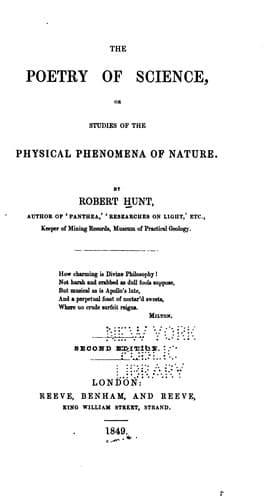
The Poetry of Science; or, Studies of the Physical Phenomena of NatureHunt, Robert
Philosophy
The Poetry of Science; or, Studies of the Physical Phenomena of Nature
Hunt, Robert
Physics; Science
Nitrogen gas may be regarded in the light of a diluent to the oxygen.
In its pure state it is only characterised by its negative properties.
It will not burn, or act as a supporter of combustion. Animals speedily
perish if confined in it; but they die rather through the absence
of oxygen than from any poisonous property of this gas. Yet, in
combination, we find nitrogen exhibiting powers of a most energetic
character. In addition to the fulminating compounds and the explosive
substances already named, which are among the most remarkable instances
of unstable affinity with which we are acquainted, we have also the
well-known pungent body, ammonia. From the analogous nature of this
volatile compound, and the fixed alkalies soda and potash, it was
inferred that it must, like them, be an oxide of a metallic base. Davy
exposed ammonia to the action of potassium, and to the influence of the
voltaic arc produced from 2,000 double plates, without at all changing
its character. From its slight tendency to combination, and from its
being found abundantly in the organs of animals feeding on substances
that do not contain it, it is, however, probably a compound body. A
phenomenon of an obscure and mysterious character is presented in the
formation of the “ammoniacal amalgam,” as it is called.
Mercury, being mixed with an ammoniacal salt, is exposed to powerful
galvanic action; and a compound, maintaining its metallic appearance,
but of considerable lightness and very porous, presents itself.[229]
This preparation has been carefully examined by Davy, Berzelius, and
others. It is always resolved into ammonia and mercury; and, although
the latter chemist is strongly inclined to regard it as affording
evidence of the compound nature of nitrogen,--and he has, indeed,
proposed the name _nitricum_ for its hypothetical base,--yet, to the
present time, we have no satisfactory explanation of this apparent
metallization of ammonia.
Public-domain text, read in full here on John Shaqi.
Reviews
Reviews
No reviews yet
Be the first to share your thoughts on this work.
Elsewhere in the archive
Join the Discussion
Join the discussion
Sign in to leave a comment or review.
Sign InorCreate an account