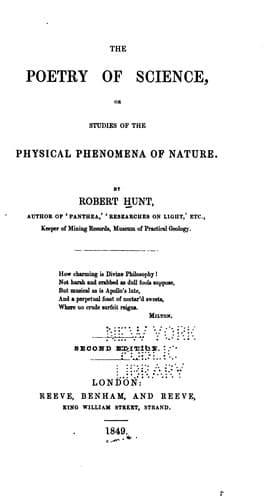
The Poetry of Science; or, Studies of the Physical Phenomena of NatureHunt, Robert
Philosophy
The Poetry of Science; or, Studies of the Physical Phenomena of Nature
Hunt, Robert
Physics; Science
No attempt will be made to describe the various elementary substances
which come under the class of metallic bodies, much less to enumerate
their combinations. Many of the metals, as silver and copper, are found
sometimes in a native state, or nearly pure; but, for the most part,
they exist, in nature, in combination with oxygen or sulphur; gold
furnishing a remarkable exception. They are occasionally found combined
with other bodies,--as oxidized carbon, phosphorus, chlorine, &c.; but
these cases are by no means so common. Those substances called metals
are generally found embedded in the rocks, or deposited in fissures
formed through them; but it is one of the great discoveries of modern
science, that those rocks themselves are metallic oxides. With metals
we generally associate the idea of great density; but potassium and
sodium, the metallic bases of potash and soda, are lighter than water,
and they consequently float upon that fluid. We learn, therefore, from
the researches of science, that the crust of this earth is composed
entirely of metals, combined with gaseous elements; and there is
reason for believing that one, or perhaps two, of the gases we have
already named are also of a metallic character. Strange as it may
appear, there is nothing, as will be seen on attentive consideration,
irrational in this idea. Many of the metals proper, under the influence
of such heat as we can, by artificial means, command, are dissipated
in vapour, and may be maintained in this state perfectly invisible.
Indeed, the transparent space above the surface of the mercury in the
tube of a barometer, known as the Torricellian vacuum, is filled with
the vapour of mercury. There is, therefore, no reason why nitrogen,
or even hydrogen, should not be metallic molecules kept by the force
of the repulsive powers of heat, or some other influence, at a great
distance from each other. The peculiar manner in which nitrogen unites
with mercury, and the property which hydrogen possesses of combining
with antimony, zinc, arsenic, potassium, sodium, and possibly other
metals, besides its union with sulphur and carbon--in all which cases
there is no such change of character as occurs when they combine with
oxygen--appear to indicate bodies which, chemically, are not very
dissimilar to those metals themselves, although, physically, they have
not the most remote resemblance.
“We know nothing,” says Davy, “of the true elements belonging to
nature; but, so far as we can reason from the relations of the
properties of matter, hydrogen is the substance which approaches
nearest to what the elements may be supposed to be. It has energetic
powers of combination, its parts are highly repulsive as to each
other, and attractive of the particles of other matter; it enters into
combination in a quantity very much smaller than any other substance,
and in this respect it is approached by no known body.”[230]
Public-domain text, read in full here on John Shaqi.
Reviews
Reviews
No reviews yet
Be the first to share your thoughts on this work.
Elsewhere in the archive
Join the Discussion
Join the discussion
Sign in to leave a comment or review.
Sign InorCreate an account