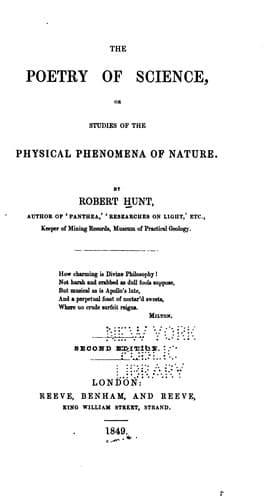
The Poetry of Science; or, Studies of the Physical Phenomena of NatureHunt, Robert
Philosophy
The Poetry of Science; or, Studies of the Physical Phenomena of Nature
Hunt, Robert
Physics; Science
Many of the elements are common to the three kingdoms of nature:
most of those found in one condition of organization are discovered
in another. The carbonates are an abundant mineral class. In the
vegetable kingdom we find carbon combining with oxygen, hydrogen, and
nitrogen: these elements, also, constitute the substance of animals,
the proportion of nitrogen being, however, much larger. If one element,
more than another, belongs especially to the animal economy, it is
phosphorus, although this is not wanting in the vegetable world; and
it is not uncommon in the mineral. Sulphur is common to the three
kingdoms: it is abundant in the mineral, being one of the products of
volcanic action; it is united with the metals, forming sulphurets;
and is found in our rocks in the state of sulphuric acid or oxidized
vapour, combined with the metallic bases of lime and other earths. In
the vegetable kingdom we discover sulphur in all plants of the onion
kind, in the mustard, and some others; it enters into the composition
of vegetable albumen, and appears always combined with albumen,
fibrine, and caseine, in the animal economy.
Chlorine is found most abundantly in combination with sodium, as common
salt: in this state, in particular, we may trace it from the depths
of the earth, its waters, and its rocks, to the plants and animals
of the surface. Iodine is most abundant in marine plants; but it has
been found in the mineral world, traced to plants, and it is indicated
in the flesh of some animals. Bromine is known to us as a product of
certain saline waters, and a few specimens of natural bromide of silver
have been examined. Fluorine, the base of the acid which, combining
with lime, forms fluor-spar, is found to exist to some considerable
extent in bones; it has been discovered in milk and blood; and
investigations have proved its existence in the vegetable world. It
must not be forgotten that the earths, lime and magnesia, enter into
the composition of the more solid parts of plants and animals. Lime is
one of the principal constituents of animal bone and shells, and it is
found in nearly all vegetables.
Silica, or the _earth_ of flints, is met with in beautiful transparent
crystals, in the depths of the mine; in all rock and soils we find it.
In the bark of many plants, particularly the grasses, it is discovered,
forming the hard supporting cuticle of the stalk, in wheat, the Dutch
rush, the sugar-cane, the bamboo, and many other plants.
It is thus that we find the same elementary principle presenting itself
in every form of matter, under the most Protean shapes. Numerous
phenomena of even a more striking character than those selected, are
exhibited in every department of chemistry; but within the limits of
this essay it is impracticable to speak of any beyond those which
directly explain natural phenomena.
Public-domain text, read in full here on John Shaqi.
Reviews
Reviews
No reviews yet
Be the first to share your thoughts on this work.
Elsewhere in the archive
Join the Discussion
Join the discussion
Sign in to leave a comment or review.
Sign InorCreate an account