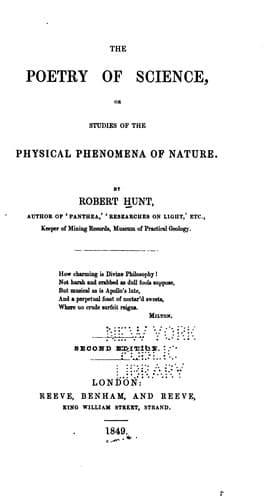
The Poetry of Science; or, Studies of the Physical Phenomena of NatureHunt, Robert
Philosophy
The Poetry of Science; or, Studies of the Physical Phenomena of Nature
Hunt, Robert
Physics; Science
The foundation of the superficial crust of the earth appears to be
formed of a class of rocks which have resulted from the slow cooling
of an immense mass of heated matter. These rocks have been called
_igneous_; but are now more generally termed _Plutonic_ (such as
granites, syenites, &c.) Immediately above these, we find rocks which
have resulted by deposition from water. These masses, having been
exposed to the action of the heat below, have been considerably changed
in their character, and hence they are often called _metamorphic_;
but metamorphic rocks may, however, be of any age. The rocks formerly
termed the _transition_ series--from their forming the connecting link
between the earlier formations--are now, from the circumstance of their
being fossiliferous, classed under the general term of palæozoic rocks,
to distinguish them from the rocks in which no organic remains have
been found. Above these are found the secondary strata, and, still more
recently produced, we have a class now usually denominated the tertiary
formations. “Eternal as the hills” is a poetic expression, implying a
long duration; but these must, from the nature of things, eventually
pass away. The period of time necessary for the disintegration of a
granite hill is vastly beyond the powers of computation, according
to our conception of the ordinary bounds of finite things. But a
consideration of the results of a few years,--under the influence of
the atmosphere and the rains,--as shown in quantity of solid matter
carried off by the rivers, and deposited at their mouths, will tend to
carry conviction to every mind, that a degrading process is for ever in
action on the surface of the earth. The earth itself may be eternal,
but the surface is continually undergoing mutation, from various
causes, many of which we must briefly consider.[232]
Public-domain text, read in full here on John Shaqi.
Reviews
Reviews
No reviews yet
Be the first to share your thoughts on this work.
Elsewhere in the archive
Join the Discussion
Join the discussion
Sign in to leave a comment or review.
Sign InorCreate an account