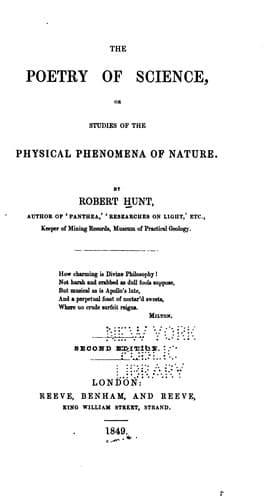
The Poetry of Science; or, Studies of the Physical Phenomena of NatureHunt, Robert
Philosophy
The Poetry of Science; or, Studies of the Physical Phenomena of Nature
Hunt, Robert
Physics; Science
In regarding geological phenomena, the absence of any fossil remains
has often been supposed to indicate a period previous to any organic
formations. The inorganic constituents of matter are probably of
prior origin to the organic combinations; the vessel was constructed,
upon which the organic creation was to float in space before any
vital organisms were created. The supposed evidences in favour of the
assumption that there was no organic life during the formation of the
oldest rocks we know, are in some respects doubtful; and we can well
understand that changes may have been induced in the earlier rock
formations, by heat or by other powers, quite sufficient to destroy all
traces of organized forms. It was long thought that phosphoric acid was
not to be detected in rocks which are regarded as of igneous origin;
and since this acid is peculiarly a constituent of organic bodies, this
has been adduced as a proof that the plutonic rocks must have existed
previously to the appearance of vegetable or animal life upon the
surface of the globe. The researches of modern chemists have, however,
shown that phosphoric acid is to be found in formations of granitic
origin, in porphyry, basalt, and hornblende rocks.[233] If, therefore,
we are to regard this substance as of organic origin, the rational
inference is against the speculation; but there is no more necessity
for supposing phosphorus to be formed in the animal economy than in
the mineral kingdom, from which it will probably be found the animal
obtained it.
Without attempting to enter into any account of the apparent progress
of life over the earth, it appears desirable that some description
should be given of the kinds of plants and animals which we know to
have existed at different epochs. We shall thus learn, at least, some
of the prevailing characteristics of the earth during its transitions,
and be in a better condition for applying our knowledge of physical
power to the explanation of the various geological phenomena.
Among the earliest races we have those remarkable forms, the
trilobites, inhabiting the ancient ocean.
These crustacea bear some resemblance, although a very remote one, to
the common wood-louse, and, like that animal, they had the power of
rolling themselves into a ball when attacked by an enemy. The eye of
the trilobite is a most remarkable organ; and in that of one species,
_Phacops caudatus_, not less than two hundred and fifty lenses have
been discovered. This remarkable optical instrument indicates that
these creatures lived under similar conditions to those which surround
the crustacea of the present day.
At the period of the trilobites of the Silurian rocks, all the animals
contemporaneous with them had the organs necessary for the preservation
of life in the waters.
Public-domain text, read in full here on John Shaqi.
Reviews
Reviews
No reviews yet
Be the first to share your thoughts on this work.
Elsewhere in the archive
Join the Discussion
Join the discussion
Sign in to leave a comment or review.
Sign InorCreate an account