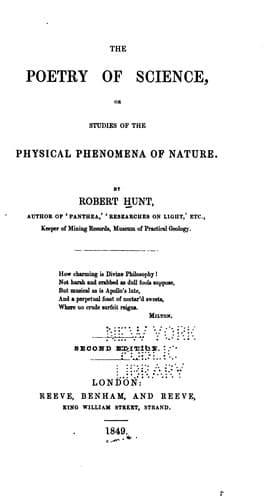
The Poetry of Science; or, Studies of the Physical Phenomena of NatureHunt, Robert
Philosophy
The Poetry of Science; or, Studies of the Physical Phenomena of Nature
Hunt, Robert
Physics; Science
Next in order of time to the trilobite, the most singular animals
inhabiting those ancient seas, whose remains have been preserved,
are the _Cephalopoda_, possessing some traces of organs which belong
to vertebrated animals. There are numerous arms for locomotion and
prehension, arranged in a centre round the head, which is furnished
with a pair of sharp, horny mandibles, embedded in powerful muscles.
These prehensile arms are provided with a double row of suckers, by
which the animal seized its prey. Of these cephalopodous animals there
are many varieties, but all of them appear to be furnished with powers
of rapid locomotion, and those with shells had an hydraulic arrangement
for sinking themselves to any depth of the seas in which, without
doubt, they reigned the tyrants.
Passing by without notice the numerous fishes, which appear to have
exhibited a similar order of progression to the other animals, we must
proceed to the more remarkable period when the dry land first began to
appear.
All the animals found in the strata we have mentioned are such as would
inhabit the seas; but we gradually arrive at distinct evidence of the
separation of the land from the water, and the “green tree yielding
seed” presents itself to our attention; not that the strata earlier
than this are entirely destitute of any remains indicating vegetable
growth, but those they exhibit are such as, in all probability, may be
referred to marine plants.
Those plants, however, which are found in the carboniferous series
are most of them distinguished by all the characteristics of those
which grow upon the land; we, therefore, in the mutilated remains of
vegetation left us in our coal-formations, read the history of our
early world.
Then the reed-like calamite bowed its hollow and fragile stems over
the edges of the lakes the tree-ferns grew luxuriantly in the shelter
of the hills, and gave a wild beauty to the humid valleys; the
lepidodendrons spread themselves in mighty forests along the plains,
which they covered with their curious cones; whilst the sigillariæ
extended their multitudinous branches, wreathing like serpents amongst
the luxurious vegetation, and embraced, with their roots (stigmariæ), a
most extensive space on every side.[234]
The seas and lakes of this period abounded with minute animals nearly
allied to the coral animals, which are now so actively engaged in the
formation of islands in the tropical and southern seas. During the ages
which passed by without any remarkable disturbance of the surface of
the earth, the many bands of mountain limestone were formed by the
ceaseless activity of these minute architects. Encrinites (creatures
in some respects resembling star-fish) existed in vast numbers in the
oceans of this time; and the great variety of bivalve shells, and those
of a spiral character, discovered in the rocks of this period, show the
waters of the newer palæozoic period to have been instinct with life.
Public-domain text, read in full here on John Shaqi.
Reviews
Reviews
No reviews yet
Be the first to share your thoughts on this work.
Elsewhere in the archive
Join the Discussion
Join the discussion
Sign in to leave a comment or review.
Sign InorCreate an account