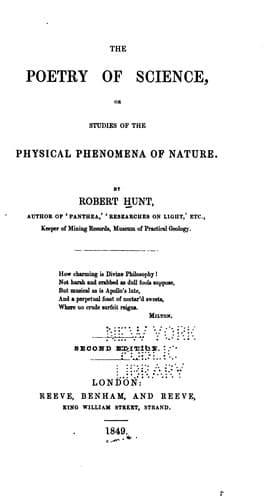
The Poetry of Science; or, Studies of the Physical Phenomena of NatureHunt, Robert
Philosophy
The Poetry of Science; or, Studies of the Physical Phenomena of Nature
Hunt, Robert
Physics; Science
The inferences drawn from a careful study of the condition of our own
globe are in favour of the assumption of the existence of nebulous
matter. By the processes of art and manufacture, by the operation of
those powers on which organisation and life depend, solid matter is
constantly poured off in such a state that it cannot be detected, _as
matter_, by any of the human senses. Yet a thousand results, daily and
hourly accumulating as truths around us, prove that the solid metals,
the gross earths, and the constituents of animal and vegetable life,
all pass away invisible to us, and become “thin air.” We know that,
floating around us, these volatilized bodies exist in some material
form, and numerous experiments in chemistry are calculated to convince
us, that the most attenuated air is capable, with a slight change
of circumstances, of being converted into the condition of solid
masses. Hydrogen gas, the lightest, the most ethereal of the chemical
elements, dissolves iron and zinc, arsenic, sulphur, and carbon; and
from the transparent combinations thus formed, we can with facility
separate those ponderous bodies. Such substances must exist in our
own atmosphere; why not in the regions of space? Whether this planet
ever floated a mass of nebulous matter, only known by its dim and
filmy light, or comet-like rushed through space with widely eccentric
orbit, are questions which can only receive the reply of speculative
minds. Whether the earth and the other members of the Solar System were
ever parts of a Central Sun,[18] and thrown from it by some mighty
convulsion, though now revolving with all the other masses around that
orb, chained in their circuits by some infinite power, is beyond the
utmost refinements of science to discover. This hypothesis is, however,
in its sublime conception, worthy of the master-mind that gave it birth.
All we know is, that our earth is an oblate sphere, which, by the
effects of its rotation around an axis, is somewhat enlarged at the
equator and flattened at the poles;--that it maintains its regular
course around the sun, in virtue of the operation of two forces, one
of which, acting constantly, would eventually draw it into the body
of the sun itself; but that it is opposed by the other, centrifugal
force, and the varying momentum of the revolving mass;--that the same
force acting from the centre of the earth itself, and from the centre
of every particle of its substance, resolves the whole into a globular
form.
Public-domain text, read in full here on John Shaqi.
Reviews
Reviews
No reviews yet
Be the first to share your thoughts on this work.
Join the Discussion
Join the discussion
Sign in to leave a comment or review.
Sign InorCreate an account