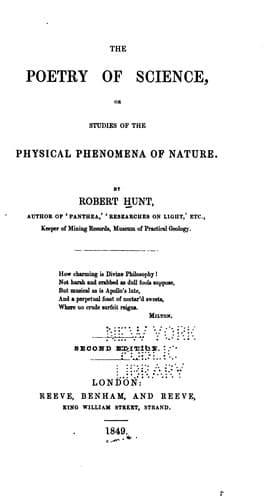
The Poetry of Science; or, Studies of the Physical Phenomena of NatureHunt, Robert
Philosophy
The Poetry of Science; or, Studies of the Physical Phenomena of Nature
Hunt, Robert
Physics; Science
The most remarkable phenomena connected with these animals are the
metamorphoses which they undergo. The female butterfly, for instance,
lays eggs, which, when hatched, produce caterpillars: these live in
this state for some time, feeding upon vegetables, and, after casting
their skins as they increase in size, at last assume an entirely
different state, and, dormant in their oblong case, they appear like
dead matter. This chrysalis, or pupa, is generally preserved from
injury by being embedded in the earth, from which, after a season, a
beautifully perfect insect escapes, and, floating on the breeze of
summer, enjoys its sunshine, and revels amidst its flowers.
No less remarkable is the metamorphosis of the caducibranchiate
amphibia, passing through the true fish condition of the tadpole to the
perfect air-breathing and four-footed animal, the frog.
A metamorphosis of the crustaceans, somewhat similar to that which
takes place in insects, has been of late years creating much discussion
amongst naturalists: but the question appears to be now settled by the
careful and long-continued observations of Mr. Thompson and Mr. R. C.
Couch.
A wide line of demarcation marks the separation of the invertebrata
from the four great classes of vertebrate animals--fishes, reptiles,
birds, and mammalia. Every part of the globe,--the ocean and the inland
lake,--the wide and far-winding river, and the babbling stream,--the
mountain and the valley,--the forest with its depth of shade, and
the desert with its intensity of light,--the cold regions of the
frost-chained north, and the fervid clime within the tropics--presents
for our study innumerable animals, each fitted for the conditions to
which it is destined; and through the whole we find a gradual elevation
in the scale of intelligence, until at last, separated from all by
peculiar powers, we arrive at man himself.
In each of these four classes the animals are furnished with a bony
skeleton, which is in the young animal little more than cartilage;
but, as growth increases, lime becomes deposited, and a sufficient
degree of hardness is thus produced to support the adult formation.
Some anatomists have endeavoured to show that even in the mechanical
structure of the bony fabrics of animals, we are enabled to trace a
gradual increase in the perfection of arrangement, from the fish until
the most perfect is found in man. Many of the mammalia, however, are
furnished with skeletons which really surpass that of man. These belong
to animals which depend for subsistence upon their muscular powers, and
with whom man is, in this particular, on no equality. What is the lord
of the creation, compared with the antelope for fleetness, or with the
elephant and many other animals for strength?
Public-domain text, read in full here on John Shaqi.
Reviews
Reviews
No reviews yet
Be the first to share your thoughts on this work.
Elsewhere in the archive
Join the Discussion
Join the discussion
Sign in to leave a comment or review.
Sign InorCreate an account