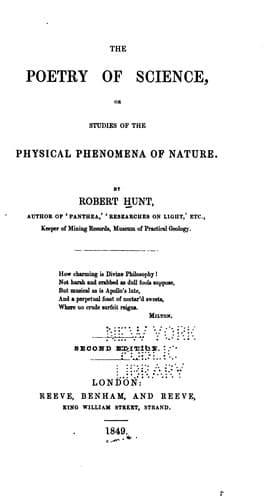
The Poetry of Science; or, Studies of the Physical Phenomena of Nature — John Shaqi
The Poetry of Science; or, Studies of the Physical Phenomena of NatureHunt, Robert
Philosophy
The Poetry of Science; or, Studies of the Physical Phenomena of Nature
Hunt, Robert
Physics; Science
In the inorganic world, where the great phenomena of life are wanting,
we have constantly exhibited the working of powers of a strangely
complicated kind. The symmetrical arrangement of crystals--the
diversified characters of mineral formations--the systematic
aggregations of particles to form masses possessing properties of a
peculiar and striking nature--all prove, that agencies, which science,
with all its refinements, has not yet detected, are unceasingly at
work. Heat, electricity, chemical power--whatever that may be--and
the forces of cohesion, are known to be involved in the production of
the forms we see; but contemplation soon leads to the conviction that
these powers are subordinate to others which we know not of. We know
only the things belonging to the surface of our planet, and these but
superficially. The geologist traces rock-formations succeeding each
other (from the primary strata holding no traces of organized forms,
through the Paleozoic series, in which, step by step, the history of
animal life is recorded,) to the more recent formations, teeming with
relics, which, though allied to some animal types still existing, are
generally such as have passed away. The naturalist searches the earth,
the waters, and the air, for their living things; and the diversity
of form, the variety of condition, and the perfection of organization
which he discovers as belonging to this our epoch--differing from,
indeed bearing but a slight relation to, those which mark the earth’s
mutations--exhibit, in a most striking view, the endless variety of
characters which matter can assume.
We are so accustomed to all these phenomena of matter, that it is with
some difficulty we can bend ourselves to the study of the more simple
conditions in which it exists.
The solid crusts of this telluric sphere--the waters and the
atmosphere--the diversified fabrics of the vegetable kingdom--and the
still more complicated structures of men and animals--are, altogether,
but the aggregation of minute particles in accordance with certain
fixed laws. By mechanical means all kinds of matter may be reduced to
powder, the fine particles of which would not appear very different
from each other, but each atom has been impressed with properties
peculiar to itself, which man has no power to change.
To nature alone belongs the mysterious property of transmutation. The
enthusiastic alchemist, by the agency of physical forces, dissipates a
metal in vapour; but it remains a metal, and the same metal still. By
the Hermetic art he breaks up the combination of masses; but he cannot
alter the principles of any one of the elements which form the mass
upon which his skill is tried.
Every atom is invested with properties peculiar to all of its class;
and each one possesses powers, to which in mute obedience it is
compelled, by which these properties are modified, and the character of
matter varied. What are those properties? Do we know anything of those
powers?
Public-domain text, read in full here on John Shaqi.
Reviews
Reviews
No reviews yet
Be the first to share your thoughts on this work.
Join the Discussion
Join the discussion
Sign in to leave a comment or review.
Sign InorCreate an account