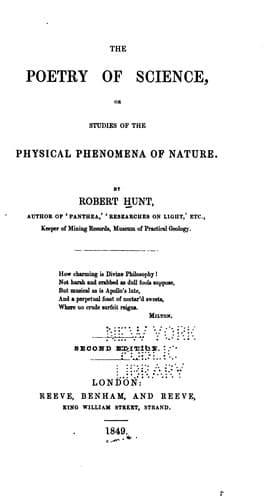
The Poetry of Science; or, Studies of the Physical Phenomena of Nature — John Shaqi
The Poetry of Science; or, Studies of the Physical Phenomena of NatureHunt, Robert
Philosophy
The Poetry of Science; or, Studies of the Physical Phenomena of Nature
Hunt, Robert
Physics; Science
The earth, so far as we are acquainted with it, is composed of about
sixty principles, which we call elementary. These are the most simple
states to which we can reduce matter, and from them all the forms of
creation yet examined by the chemist are produced. These elementary
principles are, some of them, permanently gaseous under the ordinary
temperature, and others exist as solid masses; the difference between
the two conditions being regulated, as it appears, by the opposing
forces of heat and cohesive attraction.
Matter has been regarded by some as infinitely divisible; but the known
conditions of chemical combinations lead to the conclusion that there
are limits beyond which matter cannot be divided.[25] The theory of
atoms having determinate characters, and possessing symmetric forms,
certainly has the advantage of presenting to the human mind a starting
point--a sort of standing ground,--from which it can direct the survey
of cosmical phenomena. The metaphysical hypothesis, which resolves all
matter into properties, and refers all things to ideas, leaves the
mind in a state of uncertainty and bewilderment.
Adapting the views of Dumas, with some modifications,[26] it will be
found more satisfactory to regard the _ultimate atoms_ of matter as
points beyond the reach of our examination; which, according to a law,
determined by the influences of the so-called imponderable forces,
unite to form _molecules_. Again, these molecules combine to form the
_particles_ of the mass which we may regard as the limit of mechanical
division. The particles of solid bodies are solid, those of fluids
fluid, and those of gaseous bodies are themselves aëriform; but it does
not follow that the molecules of any body should be necessarily solid,
fluid, or aëriform, from the circumstance of their having formed the
particles of a body in one of these states.
As this planet--a molecule in space--is formed of aggregated atoms, and
enveloped by its own physical agencies--and as it is involved in the
infinitely extending influences of other planetary molecules, and thus
forms part of a system--so the molecules of any mass are grouped into a
system or particle, which possesses the great characteristic features
of the whole.
In an aëriform body the particles are in a state of extreme tenuity,
the molecules being themselves, by the influence of some repulsive
force, just on the verge where cohesion exerts its decaying power. In
fluid bodies the attenuation of the particles is less--the particles
and also the molecules are nearer together,--whereas, in the solid
body, the forces of cohesion are most strongly exerted, and all the
molecular conditions brought more powerfully into action.
Public-domain text, read in full here on John Shaqi.
Reviews
Reviews
No reviews yet
Be the first to share your thoughts on this work.
Join the Discussion
Join the discussion
Sign in to leave a comment or review.
Sign InorCreate an account