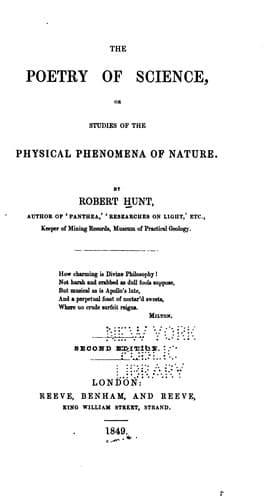
The Poetry of Science; or, Studies of the Physical Phenomena of NatureHunt, Robert
Philosophy
The Poetry of Science; or, Studies of the Physical Phenomena of Nature
Hunt, Robert
Physics; Science
Heat, and the other elementary radiant principles, are often combined
as the common cause of effects evident to our senses. The warmth of the
solar rays, and their luminous influence, are not, however, commonly
associated in the mind as the results of a single cause. It is only
when we come to examine the physical phenomena connected with these
radiations that we discover the complexity of the inquiry. Yet it is
out of these very subtle researches that we draw the most refined
truths. The high inferences to which the analysis of the subtile
agencies of creation leads us, render science, pursued in the spirit of
truth, a great system of religious instruction.
Although we do not fear that heat and light can be confounded in the
mind, so different are their phenomena,--we have heat rays, as from
dark hot iron, which give no light, while in the full flood of the
lunar rays the heat is scarcely appreciable by the most delicate
instruments;--yet it is important to show how far these two principles
have--been separated from each other. Transparent bodies have varied
powers of calorific transparency, or transcalescence: some obstructing
the heat radiated from bodies of the highest temperatures almost
entirely even in the thinnest layers; whilst others will allow the
warmth of the hand to pass through a thickness of several inches.
Liquid chloride of sulphur, which is of a deep red colour, will allow
63 out of 100 rays of heat to pass, and a solution of carmine in
ammonia, or glass stained with oxides of gold, or copper, rather a
greater number; yet these transparent media obstruct a large quantity
of light. Colourless media obstructing scarcely any light, will, on
the contrary, prevent the passage of calorific rays. Out of every
hundred rays, oil of turpentine will only transmit 31, sulphuric ether
21, sulphuric acid 17, and distilled water only 11. Pure flint glass,
however, is permeated by 67 per cent. of the thermic rays, and crown
glass by 49 per cent. The body possessing the most perfect transparency
to the rays of heat is diaphanous salt-rock, which transmits 92, while
alum, equally translucent, admits the passage of only 12 per cent.[43]
Black mica, obsidian, and black glass, are nearly opaque to light, but
they allow 90 per cent. of radiant heat to pass through them; whereas
a pale green glass, coloured by oxide of copper,[44] covered with a
layer of water, or a very thin plate of alum, will, although perfectly
transparent to light, almost entirely obstruct the permeation of heat
rays.
Public-domain text, read in full here on John Shaqi.
Reviews
Reviews
No reviews yet
Be the first to share your thoughts on this work.
Elsewhere in the archive
Join the Discussion
Join the discussion
Sign in to leave a comment or review.
Sign InorCreate an account