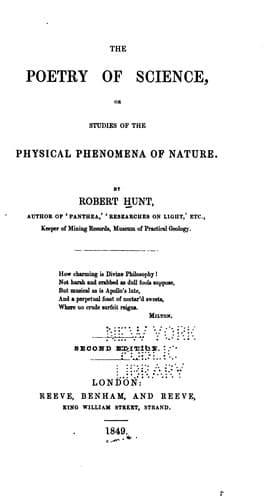
The Poetry of Science; or, Studies of the Physical Phenomena of NatureHunt, Robert
Philosophy
The Poetry of Science; or, Studies of the Physical Phenomena of Nature
Hunt, Robert
Physics; Science
We thus arrive at the fact that heat and light may be separated from
each other; and if we examine the solar beam by that analysis which the
prism affords, we shall find that there is no correspondence between
intense light and ardent heat. By careful observation, it has been
proved, when we have a temperature of 62° F. in the yellow ray, which
ray has the greatest illuminating power; that below the red ray, out of
the point of visible light, the temperature is found to be 79°, while
at the other end of the spectrum, in the blue ray, it is 56°, and at
the end of the violet ray no thermic action can be detected.[45]
From the circumstance, that as we, by artificial means, raise the
temperature of any body, and produce intense heat, so after a
certain point of thermic elevation has been obtained, we occasion a
manifestation of _light_.[46] It has been concluded, somewhat hastily,
that heat and light differ from each other only in the rapidity of the
undulations of an hypothetical ether.
It must be admitted that the mathematical demonstrations of many of the
phenomena of calorific and luminous power are sufficiently striking to
convince us that a wave-movement is common to both heat and light. The
undulatory theory, however, requires the admission of so many premises
of which we have no proof; its postulates are, indeed, in many cases
so gratuitous, that notwithstanding the array of talent which stands
forward in its support, we must not allow ourselves to be deceived by
the deductions of its advocates, or dazzled by the brilliancy of their
displays of learning.
Radiant heat appears to move in waves; but that calorific effects in
material bodies are established by any system of undulation, is a
deduction without a proof; and the thermic phenomena of matter are as
easily explained by the hypothesis of a diffusive subtile fluid.
We have not, however, to prove the correctness of either of the
opposing views; indeed, it is acknowledged that many phenomena require
for their explanation conditions which are not indicated by either
theory.
The earth receives its heat from the sun; a portion of it is
_conducted_ from particle to particle into the interior of the rocky
crust. Another portion produces warmth in the atmosphere around us,
by _convection_, or the circulation of particles; those warmed by
contact with the surface becoming lighter, and ascending to give place
to the colder and heavier ones. A third portion is radiated off into
space, according to laws which have not been sufficiently investigated,
but which are dependent upon the colour, chemical composition, and
mechanical structure of the surface.
It cannot but be instructive to contemplate the indications which we
have of the dependence of all that is beautiful on earth, on the heat
and light radiations which we receive from the sun. Let us endeavour
to realise some of the effects which arise from even the temporary
deprivation of solar heat.
Public-domain text, read in full here on John Shaqi.
Reviews
Reviews
No reviews yet
Be the first to share your thoughts on this work.
Elsewhere in the archive
Join the Discussion
Join the discussion
Sign in to leave a comment or review.
Sign InorCreate an account