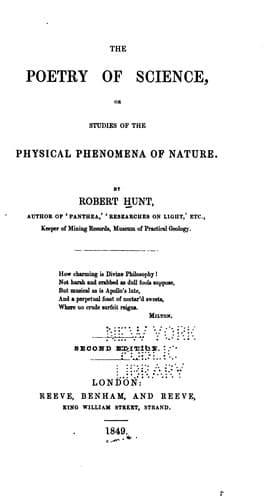
The Poetry of Science; or, Studies of the Physical Phenomena of NatureHunt, Robert
Philosophy
The Poetry of Science; or, Studies of the Physical Phenomena of Nature
Hunt, Robert
Physics; Science
It is winter, the vegetable world appears chilled to its centre. The
trees, except a few of the hardy evergreens, are bare of leaves, and
stretching forth their branches into the cold air, they realise the
condition of vegetable skeletons. The lowly plants of the hedge-row,
and the grasses of the field, show that their vital power is subdued
to that minimum degree of action which is but a few slight removes
from death. The life of the running stream is suspended, it is cased
in the “thick-ribbed ice,” and the waters beneath no longer send forth
their joyous music to the genial breeze. Even within the temperate
limits of our own land, the aspect of winter convinces the ordinary
observer, that the loss of heat has been followed by diminished
activity in the powers of life; and the philosopher discovers that the
lessened energies of solar light, and the weaker action of the radiant
heat, have aided in producing that repose which is a little more than
sleep--a little less than death.
It is night, and winter: the earth is parting with its heat,--with
the absence of light, there is a still greater loss of vigour, a yet
further diminution of the powers of life. Even the animal races,
sustained by vital influences of a more exalted kind, sink under the
temporary deprivation of the solar rays to a monotonous, a melancholy
repose. All animals undergo different degrees of hybernation, and
each in his winter retreat supports vitality by preying upon himself.
The world is hung in mourning black; there is no play of colours to
harmonize the human spirit by sending their ethereal pulsations to the
human eye, and it is only the consciousness that when the night is at
the darkest, the day is nearest, that even man’s soul is sustained
against the depressing influences of the absence of the sun.
The conditions which we must observe at our own doors cannot fail to
convey as a conviction to the least imaginative mind, that a slightly
prolonged continuance of darkness, with its consequent increase of
coldness, would be fatal to the existence of the organic world.
The sun has entered Aries: it is spring. The length of the day and
night are equal, the powers of light and darkness are now exactly
balanced against each other, and light, like the Archangel, triumphs
over the sombre spirit. The organic world awakes. Chemical action
commences in the seed, the vital spark is kindled in the embryo, and
under the impulsive force of some solar radiations the plant struggles
into light and life. The same invigorating force impels the circulation
of the sap through the capillary tubes of the forest tree, until the
topmost branch trembles with the new flow of life. The buds burst forth
into leaf, and a fresh and lively covering spreads over those branches
which, in their nakedness, could scarcely be distinguished from the
dead.
Public-domain text, read in full here on John Shaqi.
Reviews
Reviews
No reviews yet
Be the first to share your thoughts on this work.
Elsewhere in the archive
Join the Discussion
Join the discussion
Sign in to leave a comment or review.
Sign InorCreate an account