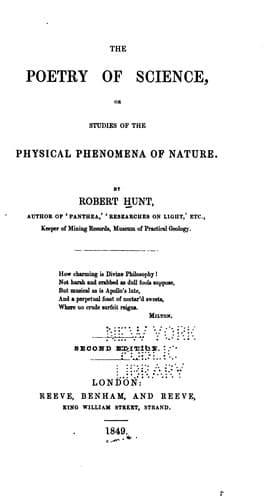
The Poetry of Science; or, Studies of the Physical Phenomena of NatureHunt, Robert
Philosophy
The Poetry of Science; or, Studies of the Physical Phenomena of Nature
Hunt, Robert
Physics; Science
The animal races are no less sensible of the new influence which is
diffused around. The birds float joyously upon the breeze, and give
to heaven their trilling songs of praise. The beasts come forth from
the clefts of the rocks and the tangled shelters of the forests, and
gambol in the full luxury of their renewed vigour. Man, even man, the
inhabitant of cities, trained and tempered to an artificial state,
awakes of a spring morning with a fuller consciousness of mind, and a
deeper and more pleased sense of his intelligence, than when the fogs
and gloom of winter hung like the charmed robe upon the limbs of the
giant. Now, the dormant poetry of man seeks expression. As the morning
sun is said to have awakened the musical undulations of the Memnonian
statue, so the sun of the vernal morning produces in the mind of the
most earthly, faint pulsations of that heaven-born music, which neither
sin nor sorrow can entirely destroy. The psychologist, in studying the
peculiar phenomena of the human mind, must associate himself with the
natural philosopher, and learn to appreciate the influence of physical
causes in determining effects which our elder philosophers and the
poets of every age have attributed to spiritual agencies.
Summer, with its increased heat and light, reigns over the land. The
work of life is now at its maximum, and every energy is quickened
throughout the organic creation. The laws of nature are arranged
on the principle of antagonistic forces, the constant struggle to
maintain them in equilibrium constituting the sensible phenomena of
existence. Heat and light, with chemical power and electricity, have
been quickening the unknown principle of life, until it has become
exhausted in the production of new parts--in the strange phenomenon of
growth--the formation of organized matter from the inorganic stores of
creation.
The autumn, with its tempered sunlight, comes, but in the solar
radiance we discover new powers, and under the influence of these the
flower and the fruit have birth. The store of a new life is centered in
the seed, and though the leaf falls, and the flower fades, a new set
of organisms are produced, by which the continuance of the species is
secured.
Let any man examine himself as the seasons change, and he will soon be
convinced that every alternation of light and darkness, of heat and
its absence, produces new sets of influences equally on the mind and
on the body, showing the entire dependence of the animal and vegetable
kingdoms upon those causes which appear to flow from the centre of our
planetary system.
The phenomena which connect themselves with the changes of the seasons
cannot fail to convince the most superficial thinker that there is an
intimate connection between the sun and the earth which deserves our
close attention.
Public-domain text, read in full here on John Shaqi.
Reviews
Reviews
No reviews yet
Be the first to share your thoughts on this work.
Elsewhere in the archive
Join the Discussion
Join the discussion
Sign in to leave a comment or review.
Sign InorCreate an account