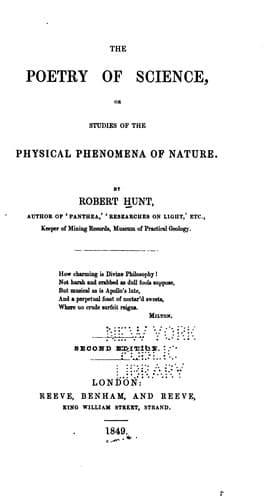
The Poetry of Science; or, Studies of the Physical Phenomena of NatureHunt, Robert
Philosophy
The Poetry of Science; or, Studies of the Physical Phenomena of Nature
Hunt, Robert
Physics; Science
We have now examined the physical conditions and properties of this
most important element, and we must proceed to learn something of the
means by which it may be developed, independently of its solar source.
This extraordinary principle exists in a latent state in all bodies,
and may be pressed out of them. The blacksmith hammers a nail until it
becomes red hot, and from it he lights the match with which he kindles
the fire of his forge. The iron has by this process become more dense,
and percussion will not again produce incandescence until the bar has
been exposed in fire to a red heat. The only inference we can draw
from this result is, that by hammering the particles have been driven
closer together, and the heat driven out; now further hammering will
not force the atoms nearer, and consequently no additional quantity of
heat can be developed; the iron is made hot in a fire, it absorbs heat,
the particles are restored to their former state, and we can now again
by hammering develope both heat and light. The Indian produces a spark
by the attrition of two pieces of wood. By friction, two pieces of ice
may be made to melt each other; and could we, by mechanical pressure,
force water into a solid state, an immense quantity of heat would be
set free. By the condensation of hydrogen and oxygen gases, pulverulent
platinum will become glowing red-hot, and, with certain precautions,
even the compact metal, platinum, itself; the heat being derived from
the gases, the union of which it has effected. A body passing from the
solid to the fluid state absorbs heat from all surrounding substances,
and hence a degree of cold is produced. The heat which is thus removed
is not destroyed--it is held combined with the fluid; it exists in a
latent state. Fluids, in passing into a gaseous form, also rob all
surrounding bodies of an amount of heat necessary to maintain the
aëriform condition. From the air or from the fluid, this heat may,
as we have shown above, be again extracted. Locked in a pint measure
of air, there exists sufficient heat to raise several square inches
of metal to glowing redness. By the compression of atmospheric air
this may be shown, and with a small condensing syringe a sufficient
quantity of heat may be set free to fire the _Boletus igniarius_,
which, impregnated with nitre, is known as _amadou_. We are acquainted
with various sources from which heat may be developed for artificial
purposes: the flint-and-steel is an example of the production of heat
by mechanical force, and the modern lucifer-match, of the combined
action of friction and chemical affinity. These of themselves would
admit of a lengthened discourse; but it is necessary that we carefully
examine some of the less familiar phenomena of heat under the
influences of changes of chemical condition.
Public-domain text, read in full here on John Shaqi.
Reviews
Reviews
No reviews yet
Be the first to share your thoughts on this work.
Elsewhere in the archive
Join the Discussion
Join the discussion
Sign in to leave a comment or review.
Sign InorCreate an account