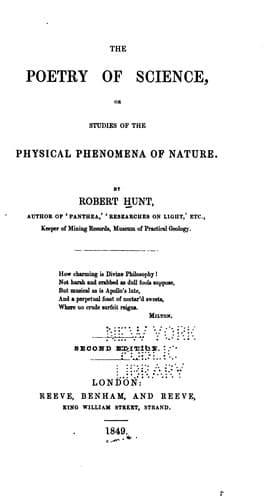
The Poetry of Science; or, Studies of the Physical Phenomena of NatureHunt, Robert
Philosophy
The Poetry of Science; or, Studies of the Physical Phenomena of Nature
Hunt, Robert
Physics; Science
If spirits of wine and water are mixed together, a considerable degree
of heat is given out, and by mixing sulphuric acid and water, an
infinitely larger quantity. If sulphuric acid (oil of vitriol) and
spirit of wine, or nitric acid (aquafortis) and spirits of turpentine,
at common temperatures, be suddenly mixed, so much heat is set free
as to ignite the spirit. In each of these instances there is a
condensation of the fluid. In nearly all cases of solution, cold is
produced by the absorption of the heat necessary to sustain the salt
in a liquid form; but when potash dissolves in water, heat is given
out, which is a fact we cannot yet explain. If potassium is placed on
water, it seizes the oxygen of the water and sets fire to the hydrogen
gas liberated by the heat produced in the change of form. Antimony
and many other metals thrown into chlorine gas ignite and burn with
brilliancy: the same phenomenon takes place in the vapours of iodine or
bromine. Many chemical combinations, as the chloride of potassium and
sulphur explode with a blow; whilst the slightest friction occasions
the detonation of the fulminating salts of silver, mercury, and
gold. Compounds of nitrogen and chlorine, or iodine, are still more
delicately combined--the former exploding with fearful violence on
the contact of any oleaginous body, and the latter by the smallest
elevation of temperature: both of them destroying the vessels in which
they may be contained.
Gun cotton presents some peculiar phenomena which may merit brief
attention. This peculiar compound is prepared by the action of nitric
acid on cotton fibre. The general appearance of the cotton is not
altered, but a remarkable physical change has taken place. It is
now soluble in ether, and forms a gelatinous compound:--it explodes
violently at a temperature which is insufficient for the combustion
of gunpowder. Indeed, from, as it would appear, slight electrical
disturbances taking place in the gun cotton itself, it not unfrequently
explodes spontaneously. These fearful disturbances of the forces
which hold bodies in combination are explained with difficulty. May
it not be, that an enormous quantity of the calorific and chemical
principles is held in a state of extreme tension around the particles
of the compound, and that the equilibrium being destroyed, the whole is
developed in destructive rapidity?
The fact of great heat being evolved during the conversion of a body
from a solid to a gaseous state, as in the explosion of gunpowder or
gun cotton, which is a striking exception to the law of latent heat, as
it prevails in most cases, admits of no more satisfactory explanation.
Public-domain text, read in full here on John Shaqi.
Reviews
Reviews
No reviews yet
Be the first to share your thoughts on this work.
Elsewhere in the archive
Join the Discussion
Join the discussion
Sign in to leave a comment or review.
Sign InorCreate an account