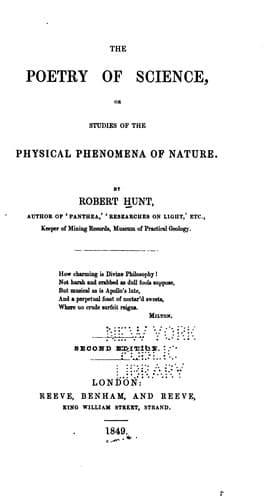
The Poetry of Science; or, Studies of the Physical Phenomena of NatureHunt, Robert
Philosophy
The Poetry of Science; or, Studies of the Physical Phenomena of Nature
Hunt, Robert
Physics; Science
As mechanical force produces calorific excitation, so we find that
every movement of sap in vegetables, and of the blood and fluids in
the animal economy, causes a sensible increase of heat. The chemical
processes constantly going on in plants and animals are another source
of heat, in addition to which nervous energy and muscular movement must
be regarded as producing the caloric which is essential to the health
and life of the latter. Digestion has been considered as a process
of combustion; and the action between the elements of food, and the
oxygen conveyed by the circulation of the blood to every part of the
body, regarded as the source of animal heat; and, without doubt, it
is one great source, although it can scarcely be regarded as the only
one.[75]
The _vis vitæ_, or vital power, influences the delicate and beautiful
system of nerves; and as life (an essence of the rarest and most
subtile order, a diffusive influence) runs through them, from the brain
to the extremities of the members of the body, it sets those tender
threads in rapid vibration, and heat is developed. By this action,
the circulation of the blood is effected; the muscle is maintained
in an elastic condition, ready to perform the tasks of the will; and
through these agencies is the warm and fluid blood fitted to receive
its chemical restoratives in the lungs, and the stomach to support
changes for which it is designed--chemical also--by which more heat
is liberated. Was digestion--_Eremacausis_, as the slow combustion
produced by combination with oxygen is called--the only source of
animal heat, why should the injury of one filmy nerve place a member of
the body for ever in the condition of stony coldness? Or why, chemical
action being most actively continued after a violent death, by the
action of the gastric juices upon the animal tissues, should not animal
heat be maintained for a much longer period than it is found to be
after respiration has ceased?[76]
In studying the influences of caloric upon the conditions of matter,
we must regard the effects of extreme heat, and also of the greatest
degrees of cold which have been obtained.
Public-domain text, read in full here on John Shaqi.
Reviews
Reviews
No reviews yet
Be the first to share your thoughts on this work.
Elsewhere in the archive
Join the Discussion
Join the discussion
Sign in to leave a comment or review.
Sign InorCreate an account