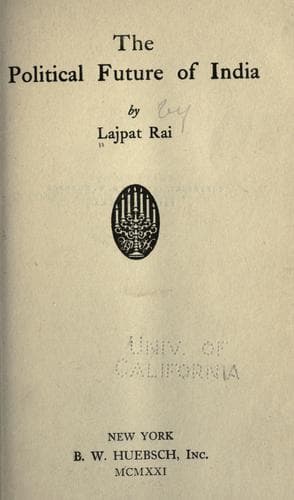
India -- History -- British occupation, 1765-1947; India -- Politics and government -- 1765-1947
The Russian Revolution first, and then the entry of the United States
into the War, brought about a change in the point of view of the British
statesmen. For the first time they realized that they could not win the
war without the fullest coöperation of the people of India, both in the
military and the economic sense and that the fullest coöperation of the
United States also required as a condition precedent, quite a radical
revision of their war aims. President Wilson's political idealism, his
short, pithy and epigrammatic formulas compelled similar declarations by
Allied statesmen. The British statesmen, at the helm of affairs, found
it necessary to affirm their faith in President Wilson's principles and
formulas if they would not let the morale of their own people at home
suffer in comparison. In the meantime the situation in India was
becoming uncomfortable. The Nationalists and the Home Rulers insisted on
a clear and unequivocal declaration of policy on the lines of President
Wilson's principles. The British statesmen in charge of Indian affairs,
at Whitehall, were still temporizing when the report of the Royal
Commission on the causes of the Mesopotamia disaster burst out on the
half-dazed British mind like a bombshell. To the awakening caused by the
report and its disclosures a material contribution was made by the
outspoken, candid and clear-cut speech of a younger statesman, whose
knowledge of the working of the Indian Government could not be
questioned. When the Parliament, press and platform were all ablaze with
indignation and shame at the supposed incompetence of the Indian
Government, to whose inefficiency and culpable neglect of duty were
ascribed the series of disasters that ended with the surrender of a
British force at Kut-el-amara, Mr. Edwin Samuel Montagu, who had been an
Under Secretary for India under Lord Morley and was at the time of the
Mesopotamia disaster Minister of Munitions, came out with a strong and
emphatic condemnation of the system and the form of Government under
which the "myriads" of India lived and had their affairs managed. Mr.
Montagu's opinion of the machinery of the Indian Government was
expressed as follows:
Public-domain text, read in full here on John Shaqi.
Reviews
Reviews
No reviews yet
Be the first to share your thoughts on this work.
Join the Discussion
Join the discussion
Sign in to leave a comment or review.
Sign InorCreate an account