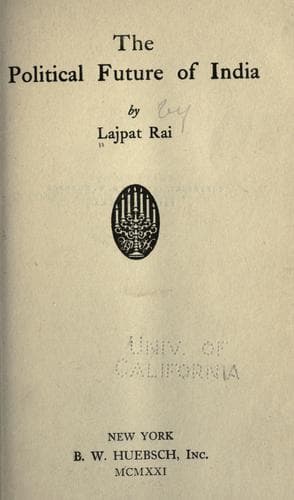
India -- History -- British occupation, 1765-1947; India -- Politics and government -- 1765-1947
"The machinery of Government in this country with its unwritten
constitution, and the machinery of Government in our Dominions has
proved itself sufficiently elastic, sufficiently capable of
modification, to turn a peace-pursuing instrument into a
war-making instrument. It is the Government of India alone which
does not seem capable of transformation, and I regard that as
based upon the fact that the machinery is statute-ridden
machinery. The Government of India is too wooden, too iron, too
inelastic, too antediluvian, to be any use for the modern purposes
we have in view. I do not believe that anybody could ever support
the Government of India from the point of view of modern
requirements. But it would do. Nothing serious had happened since
the Indian mutiny, the public was not interested in Indian
affairs, and it required a crisis to direct attention to the fact
that the Indian Government is an indefensible system of
Government."
Regarding the Indian Budget Debates in Parliament, he said:
"Does anybody remember the Indian Budget Debates before the War?
Upon that day the House was always empty. India did not matter,
and the Debates were left to people on the one side whom their
enemies sometimes called "bureaucrats," and on the other side to
people whom their enemies sometimes called "seditionists," until
it almost came to be disreputable to take part in Indian Debates.
It required a crisis of this kind to realise how important Indian
affairs were. After all, is the House of Commons to be blamed for
that? What was the Indian Budget Debate? It was a purely academic
discussion which had no effect whatever upon events in India,
conducted after the events that were being discussed, had taken
place."
He held that the salary of the Indian Secretary of State should be paid
from the British Treasury, and then there would be real debates:
"How can you defend the fact that the Secretaries of State for
India alone of all the occupants of the Front Bench, with the
possible exception of the Chancellor of the Duchy of Lancaster,
are not responsible to this House for their salaries, and do not
come here with their Estimates in order that the House of Commons
may express its opinion....
"What I am saying now is in the light of these revelations of this
inelasticity of Indian government. However much you could gloss
over those indefensible proceedings in the past, the time has now
come to alter them.
Public-domain text, read in full here on John Shaqi.
Reviews
Reviews
No reviews yet
Be the first to share your thoughts on this work.
Join the Discussion
Join the discussion
Sign in to leave a comment or review.
Sign InorCreate an account