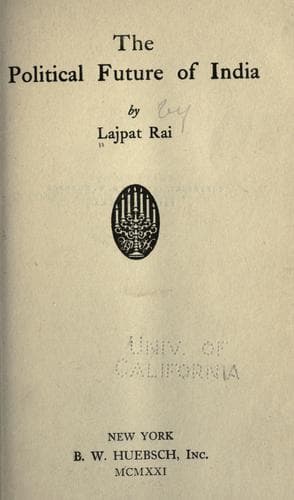
India -- History -- British occupation, 1765-1947; India -- Politics and government -- 1765-1947
"The tone of those Debates is unreal, unsubstantial and
ineffective. If Estimates for India, like Estimates for the
Secretary of State for Foreign Affairs, and the Colonial Secretary
were to be discussed on the floor of the House of Commons, the
Debates on India would be as good as the Debates on foreign
affairs. After all, what is the difference? Has it even been
suggested to the people of Australia that they should pay the
salary of the Secretary of State for the Colony? Why should the
whole cost of that building in Charles Street, including the
building itself, be an item of the Indian taxpayer's burden rather
than of this House of Commons and the people of the country?"
Can and does the House of Commons control the India Office? Here is Mr.
Montagu's answer.
"It has been sometimes questioned whether a democracy can rule an
Empire. I say that in this instance the democracy has never had
the opportunity of trying. But even if the House of Commons were
to give orders to the Secretary of State, the Secretary of State
is not his own master. In matters vitally affecting India, he can
be overruled by a majority of his Council. I may be told that the
cases are very rare in which the Council has differed from the
Secretary of State for India. I know one case anyhow, where it was
a very near thing, and where the action of the Council might
without remedy have involved the Government of India in a policy
out of harmony with the declared policy of the House of Commons
and the Cabinet. And these gentlemen are appointed for seven
years, and can only be controlled from the Houses of Parliament by
a resolution carried in both Houses calling on them for their
resignations. The whole system of the India Office is designed to
prevent control by the House of Commons for fear that there might
be too advanced a Secretary of State. I do not say that it is
possible to govern India through the intervention of the Secretary
of State with no expert advice, but what I do say is that in this
epoch now after the Mesopotamia Report, he must get his expert
advice in some other way than by this Council of men, great men
though, no doubt, they always are, who come home after lengthy
service in India to spend the first years of their retirement as
members of the Council of India.
"Does any Member of this House know much about procedure in the
India Office? I have been to the India Office and to other
offices. I tell this House that the statutory organization of the
India Office produces an apotheosis of circumlocution and red tape
beyond the dreams of any ordinary citizen."
His own idea of what should be done at that juncture was thus expressed:
Public-domain text, read in full here on John Shaqi.
Reviews
Reviews
No reviews yet
Be the first to share your thoughts on this work.
Join the Discussion
Join the discussion
Sign in to leave a comment or review.
Sign InorCreate an account