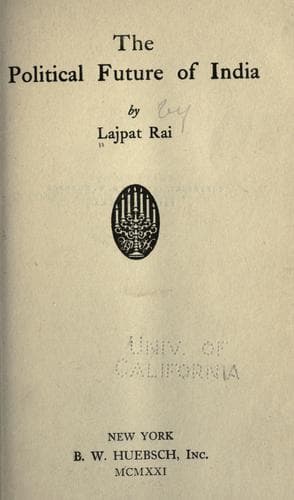
India -- History -- British occupation, 1765-1947; India -- Politics and government -- 1765-1947
_Legislation on reserved subjects_:
"For the purpose of enabling the provincial Government to get
through its legislation on reserved subjects, we propose that the
head of the Government should have power to certify that a Bill
dealing with a reserved subject is a measure 'essential to the
discharge of his responsibility for the peace or tranquillity of
the province or of any part thereof, or for the discharge of his
responsibility for the reserved subjects.'... The Bill will be
read and its general principles discussed in the full legislative
council. It will at this stage be open to the council by a
majority vote to request the Governor to refer to the Government
of India, whose decision on the point shall be final, on the
question whether the certified Bill deals with a reserved subject.
If no such reference is made, or if the Government of India decide
that the certificate has been properly given, the Bill will then
be automatically referred to a Grand Committee of the council. Its
composition should reproduce as nearly as possible the proportion
of the various elements in the larger body ... the grand committee
in every council should be constituted so as to comprise from 40
to 50 per cent. of its strength. It should be chosen for each
Bill, partly by election by ballot, and partly by nomination. The
Governor should have power to nominate a bare majority exclusive
of himself. Of the members so nominated not more than two-thirds
should be officials, and the elected element should be elected _ad
hoc_ by the elected members of the council on the system of the
transferable vote."
"On reference to the grand committee, the Bill will be debated by
that body in the ordinary course, if necessary referred to a
select committee, to which body we think that the grand committee
should have power to appoint any member of the legislative council
whether a member of the grand committee or not. The select
committee will, as at present, have power to take evidence. Then,
after being debated in the grand committee and modified as may be
determined, the Bill will be reported to the whole council. The
council will have the right to discuss the Bill again generally,
but will not be able to reject it, or to amend it except on the
motion of a member of the executive council. The Governor will
then appoint a time limit within which the Bill may be debated in
the council, and on its expiry it will pass automatically. But
during such discussion the council will have the right to pass a
resolution recording any objection which refers to the principle
or details of the measure (but not, of course, to the certificate
of its character), and any such resolution will accompany the Act
when, after being signed by the Governor, it is submitted to the
Governor General and the Secretary of State."
Public-domain text, read in full here on John Shaqi.
Reviews
Reviews
No reviews yet
Be the first to share your thoughts on this work.
Elsewhere in the archive
Join the Discussion
Join the discussion
Sign in to leave a comment or review.
Sign InorCreate an account