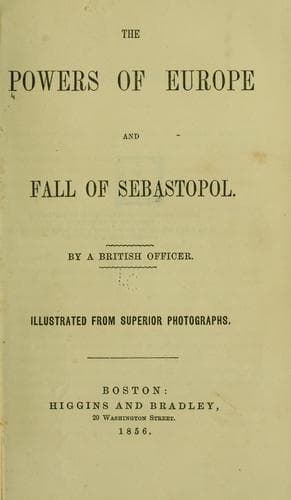
The Powers of Europe and Fall of SebastopolA British officer
History
The Powers of Europe and Fall of Sebastopol
A British officer
Crimean War, 1853-1856; Europe -- History -- 1789-1900
Crossing the Alps, the highest chain of mountains in Europe, without
roads, his artillery had to be dragged over narrow foot-paths, up
the rugged sides of frowning mountains, and on the brink of awful
precipices covered with snow; while provisions and stores for a whole
army had to be carried by sheep-paths on the backs of men. Arrived
at Geneva, having deceived the Austrians as to his intentions, he
asked General Marescot, whom he had despatched to survey Mont St.
Bernard, “Is the route practicable?” “It is barely possible,” replied
the engineer. “Let us press forward then,” said Napoleon. Arrived
at the little village of St. Pierre, everything resembling a road
ended. An immense and apparently inaccessible mountain reared its
head amidst general desolation and eternal frost, while precipices,
glaciers, and ravines appeared to forbid access to all living things.
Yet, surmounting every obstacle, the passage was accomplished; and
a French army of 30,000 men precipitated themselves, apparently
from the clouds, on the plains of Italy, and appeared to the
thunderstruck Austrians, cutting off their retreat from Genoa, and
completely dividing their forces; speedily marching upon Milan,
leaving the Austrian army under Melas, behind him, he returned to
attack them, and at the battle of Marengo gained the most important
of his victories. By the close of 1801 the continental states had
all concluded peace with France, leaving her with the most enormous
aggrandizements of territory. A short interval of peace occurred with
England in 1802, which was broken by a declaration of war in June,
1803, and all the English residents between the ages of eighteen and
sixty were detained as hostages. Hanover was seized by the French,
and the English retaliated by blockading the Elbe and the Weser.
The war with Great Britain, and a conspiracy to overthrow the
authority of the First Consul, which was discovered, served as a
ladder for Napoleon to mount from the Consulate to the Imperial
Dignity; and on the 3d May, 1804, the senate communicated to
Napoleon this address: “We think it of the last importance to the
French people to confide the government of the Republic to Napoleon
Bonaparte--HEREDITARY EMPEROR.”
The Empire was proclaimed at St. Cloud, 18th May, 1804; and Napoleon
was crowned by Pope Pius VII., on the 2d December, in the church of
Notre Dame. War was declared by Spain against England, after she
had unwarrantably attacked and seized four large Spanish frigates
filled with cargoes of immense value. The rising hostility of Russia
and Sweden at this moment incensed the French government still more
against England, to whose influence she attributed their conduct. All
appearances foretold the beginning of another general eruption.
Public-domain text, read in full here on John Shaqi.
Reviews
Reviews
No reviews yet
Be the first to share your thoughts on this work.
Join the Discussion
Join the discussion
Sign in to leave a comment or review.
Sign InorCreate an account