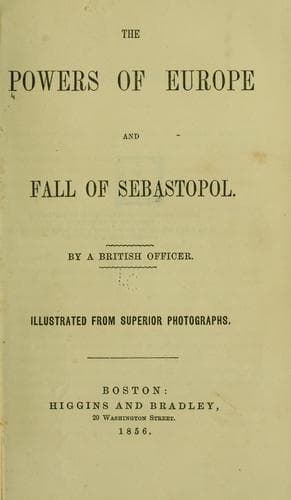
The Powers of Europe and Fall of SebastopolA British officer
History
The Powers of Europe and Fall of Sebastopol
A British officer
Crimean War, 1853-1856; Europe -- History -- 1789-1900
On the 11th of April, 1805, a treaty offensive and defensive was
formed between Russia and England, the object of which was to put
a stop to what they considered the encroachments of the French
government, and to form a general league of the states of Europe.
The accession of Austria was finally obtained to the alliance, after
great difficulty and delay: the deplorable state of her finances,
and the vacillating policy of her government, being (then as now)
stumbling-blocks in the way of negotiation. On the 31st of August,
Sweden was also included. But notwithstanding all the efforts of
England and Russia, it was found impossible to overcome the scruples
of Prussia, who inclined towards the French in hopes of obtaining
Hanover, promised her by France as a reward for her neutrality.
For ten years Prussia had flattered herself that by keeping aloof
she would avoid the storm, that she would succeed in turning the
desperate strife between France and Austria to her own benefit by
enlarging her territory, and augmenting her consideration in the
North of Germany; but at once all her prospects vanished, and it
became apparent, even to her own ministers, that this vacillating
policy was ultimately to be as dangerous as it had already been
discreditable. On the 25th of Oct., the Emperor Alexander arrived
at Berlin, and employed the whole weight of his great authority,
and all the charms of his captivating manners, to induce the King
to embrace a more manly and courageous policy; and on the 3rd of
November a secret convention was signed between the two monarchs
for the regulation of the affairs of Europe, and the erection of a
barrier against the ambition of the French Emperor. The conclusion
of the Convention was followed by a scene as remarkable as it was
romantic. Inspired with a full sense of the dangers of the war,
the ardent and chivalrous mind of the Queen conceived the idea of
uniting the two sovereigns by a bond more likely to be durable than
the mere alliances of cabinets with each other. This was, to bring
them together at the tomb of the great Frederick. The Emperor who
was desirous of visiting the mausoleum of that illustrious hero,
accordingly repaired to the church at Potsdam, where his remains are
deposited.
And at midnight the two monarchs proceeded together by torchlight
to the hallowed grave. Uncovering when he approached the spot, the
Emperor kissed the pall, and taking the hand of the King of Prussia,
as it lay on the tomb, they swore an eternal friendship to each
other, and bound themselves by the most solemn oaths to maintain
their engagements inviolate in the great contest for European
independence in which they were engaged.
Public-domain text, read in full here on John Shaqi.
Reviews
Reviews
No reviews yet
Be the first to share your thoughts on this work.
Join the Discussion
Join the discussion
Sign in to leave a comment or review.
Sign InorCreate an account