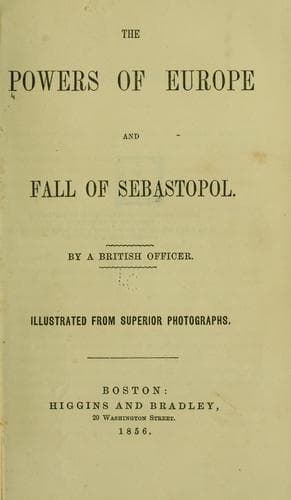
The Powers of Europe and Fall of SebastopolA British officer
History
The Powers of Europe and Fall of Sebastopol
A British officer
Crimean War, 1853-1856; Europe -- History -- 1789-1900
It would have been well for the Allies, if, when Prussia had thus
taken her part, her cabinet had possessed sufficient resolution
to have taken the field instead of continuing in her old habit
of temporizing, and thus permitting Napoleon to continue without
interruption his advance on Vienna. But her long indecision had been
her ruin. Her territory had been violated by France, who, while
apparently her ally, was reserving for her only the melancholy
privilege of being last destroyed.
In the meantime, a combined force of English, Russians, and Swedes,
thirty thousand strong, had been landed in Hanover, and the Prussian
troops occupying that Electorate had offered no resistance--a sure
proof to Napoleon of a secret understanding between the Cabinet of
Berlin and that of London.
While she was thus giving daily proofs of her indecision and
treachery, the ever-vigilant Bonaparte was pouring his armies through
Bavaria into Austria and concentrating his divisions for the sweeping
victory which was so soon afterwards destined to scatter to the winds
the opposing allies.
We now come to the campaign of Austerlitz; the most remarkable, in a
military point of view, which the history of the war afforded.
In the beginning of August the French army was cantoned on the
heights of Boulogne; and by the first week of December, Vienna was
taken, and the strength of Austria and Russia prostrated.
The allied armies presented a total of 80,000 men, including a
division of the imperial guard under the Grand Duke Constantine,
brother of the Emperor of Russia.
The forces which Napoleon had to resist this great array hardly
amounted to 70,000 combatants.
On the 30th November, 1805, the light troops of the Allies were seen
from the French outposts marching across their position towards the
right of the army. Napoleon spent the whole of both days on horseback
at the advanced posts watching their movements. At length on the
morning of the 1st Dec. the intentions of the enemy were clearly
manifested, and Napoleon beheld with “inexpressible delight” their
whole columns dark, and massy, moving across his position at so short
a distance as rendered it apparent a general action was at hand.
Carefully avoiding the slightest interruption to their movement, he
merely watched with intense anxiety their march, and when it became
evident that the resolution to turn the right flank of the French
army had been decided upon, he exclaimed, prophetically--“To-morrow,
before night-fall, that army is mine.”
At four in the morning the Emperor was on horseback. All was still
among the immense multitude concentrated in the French lines. Buried
in sleep the soldiers forgot alike their triumphs and the dangers
they were about to undergo. Gradually, however, a confused murmur
arose from the Russian host, and all the reports from the outposts
announced that the advance had already commenced along the whole line.
Public-domain text, read in full here on John Shaqi.
Reviews
Reviews
No reviews yet
Be the first to share your thoughts on this work.
Join the Discussion
Join the discussion
Sign in to leave a comment or review.
Sign InorCreate an account