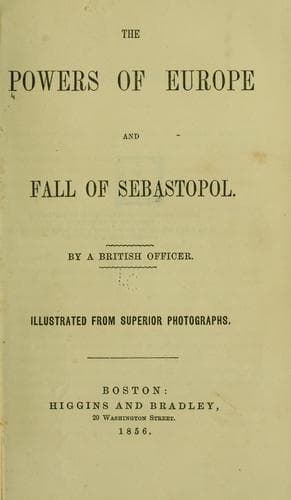
The Powers of Europe and Fall of SebastopolA British officer
History
The Powers of Europe and Fall of Sebastopol
A British officer
Crimean War, 1853-1856; Europe -- History -- 1789-1900
The British lines kept up a hot fire throughout the whole day;
but though at times nearly one hundred shot and shell were thrown
per minute, little or no effect was produced upon the Russian
intrenchments. The enemy were provided with a perfectly inexhaustible
supply of all the material requisite for a desperate defence. The
instant a shot or shell struck their works the hole was filled
up with sand-bags; so that the besieged built up as fast as the
besiegers knocked down.
The French had repaired their injuries during the night, and resumed
their fire; but they were still terribly overmatched; and, for the
third time, one of their magazines was blown up, doing much damage.
During the following night the French not only repaired their works,
but in order to fire with more destructive effect, advanced one
strong battery about two hundred yards nearer the enemy. This new
advanced battery not only enabled them to maintain their ground, but
even to destroy and silence their inveterate assailant, the Russian
ten-gun battery.
During the 22d the cannonade from the French lines was incessant, and
told with great effect; but early in the day the British batteries
received orders to fire only once in eight minutes--occasioned by a
deficiency of ammunition. The Russians worked their guns with great
energy and precision, even under the hottest fire, standing to their
pieces as boldly as on the first day of the siege; and they continued
to repair each night the injury done to their works in the previous
day. The loss of the Allies up to this point of the siege was about
twelve hundred men.
One feature in the memorable siege was the great use made of riflemen
by the besieging force, and the extreme gallantry displayed by these
men when at work.
Every day parties of skirmishers went out from the Allied lines, and
lay under cover among the loose large stones about one thousand yards
in advance of the batteries, and within two hundred yards of the
Russian defences.
This compelled the enemy to send out parties to dislodge them, and
these, as they advanced for that purpose across the open ground,
became exposed to the fire both of the skirmishers and of the
trenches, and usually suffered severely.
On one occasion a private in the British lines who had fired his
last cartridge, was crouching along the ground to join the nearest
covering-party, when two Russians suddenly sprang from behind a rock,
and seizing him by the collar, dragged him off towards Sebastopol.
Public-domain text, read in full here on John Shaqi.
Reviews
Reviews
No reviews yet
Be the first to share your thoughts on this work.
Elsewhere in the archive
Join the Discussion
Join the discussion
Sign in to leave a comment or review.
Sign InorCreate an account