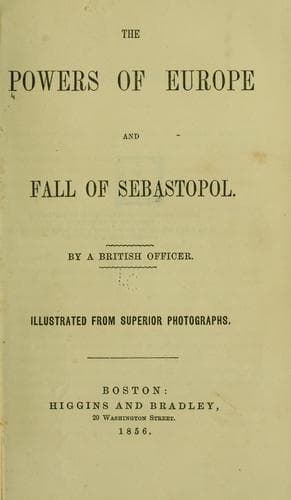
The Powers of Europe and Fall of SebastopolA British officer
History
The Powers of Europe and Fall of Sebastopol
A British officer
Crimean War, 1853-1856; Europe -- History -- 1789-1900
The Russian who escorted him on the left side held in his right
hand his own firelock, and in his left the captured Minié; with a
sudden spring the British soldier seized the Russian’s firelock,
shot its owner, clubbed his companion, and then, picking up his
own Minié, made off in safety to his own lines. Another of these
fellows resolved to do more work on his own account, got away from
his company, and crawled up close to a battery under shelter of a
bridge. There he lay on his back, and loaded, turning over to fire;
until, after killing eleven men, a party of Russians rushed out and
he took to his heels; but a volley fired after him levelled him with
the earth, and his body was subsequently picked up by his comrades
riddled with balls.
Probably 100,000 shot and shell a-day, exclusive of night-firing, was
the average amount of projectiles discharged by both parties in the
extraordinary siege.
The darkness of night was constantly interrupted by the bursting of
shell or rockets.
The passage of the shells through the air, thrown to an amazing
height from the mortars, appeared like that of meteors. To the eye,
the shell seems to rise and fall almost perpendicularly; sometimes
burning, as it turns on its axis, and the fuse disappears in the
rotation, with an interrupted pale light; sometimes with a steady
light, not unlike the calm luminosity of a planet. As it travels it
can be heard, amid the general stillness, uttering in the distance
its peculiar sound, like the cry of the curlew. The blue light in a
battery announces the starting of a rocket, which pursues its more
horizontal course, followed by a fiery train, and rushes through the
air with a loud whizzing noise that gives an idea of irresistible
energy. So went on, day and night, ceaselessly, this unparalleled
bombardment--a cataract of war, a Niagara of all dread sounds, whose
ceaseless booming was heard for long miles around. Ship after ship,
nearing the Crimean shores, heard from afar that dull, heavy sound,
and all eyes were strained to catch sight of the dread scene, of that
valley where the battle of Europe was being fought, where the cannon
were ever sounding, and “the fire was not quenched.”
BATTLE OF BALAKLAVA.
While the operations were being carried on around the walls of
Sebastopol, events of, if possible, still greater importance were
taking place a few miles off, upon the flanks and rear of the
investing force. In truth, the Allies were as much besieged as
besiegers. For about a fortnight after the affair at Mackenzie’s
Farm, on the 25th of September, nothing had been seen of the enemy,
who had retired towards Bakshi-serai to await reinforcements. It was
towards the end of the first week of October that the Russians began
to assume the offensive. The Allies at first seem to have regarded
their position as unassailable; but the enemy, thoroughly acquainted
with every foot of the country, and consequently able to advance in
the dark, soon showed them their mistake.
Public-domain text, read in full here on John Shaqi.
Reviews
Reviews
No reviews yet
Be the first to share your thoughts on this work.
Elsewhere in the archive
Join the Discussion
Join the discussion
Sign in to leave a comment or review.
Sign InorCreate an account