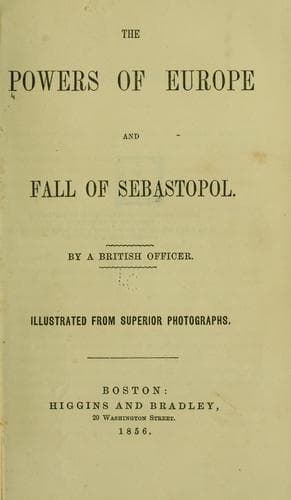
The Powers of Europe and Fall of SebastopolA British officer
History
The Powers of Europe and Fall of Sebastopol
A British officer
Crimean War, 1853-1856; Europe -- History -- 1789-1900
The British occupied a convex line of heights, stretching from the
Tchernaya, near its mouth, to the sea-coast, midway between Cape
Chersonese and Balaklava. On the north-east is a valley or plain, not
level, but broken by little eminences, about three miles long by two
in width.
Towards the Tchernaya this valley is swallowed up in a mountain
gorge and deep ravines, above which rise tier after tier of desolate
whitish rocks. At its other extremity the valley in a similar manner
contracts into a gorge, through which the high road passes, leading
down to Balaklava.
On the crest of the Allied line of heights, overlooking this plain,
the French had constructed very formidable intrenchments, mounted
with a few guns and lined by Zouaves and artillerymen.
Intersecting the plains, about two miles and a half from Balaklava,
is a series of conical heights, the highest and farthest off of which
joins the mountain range on the opposite side of the valley, while
the nearest one was commanded by the French intrenchments. On these
eminences earth-work redoubts had been constructed, each mounted with
two or three pieces of heavy ship guns, and manned by 250 Turks.
At the end of the plain next Balaklava, and stationed at the mouth of
the gorge leading down to it, were the 93d Highlanders.
In the plain, about ten miles from Balaklava, were picketed the
cavalry, commanded in chief by the Earl of Lucan, consisting of the
Light Brigade, 607 strong, and the Heavy Brigade, mustering 1000
sabres.
Such was the position of the rearward forces of the Allies on the
morning of the 25th October, 1854, when the Russians, under General
Liprandi, starting from Kamara about five o’clock, advanced to
attack them. The cavalry pickets, riding in haste, soon brought
intelligence of the attack to the Allied head-quarters, and measures
were instantly taken to forward all the troops that could be spared
from before Sebastopol to the menaced point.
The Duke of Cambridge and Sir George Cathcart were ordered to advance
with the 1st and 4th divisions with all speed, while Bosquet’s French
division received similar orders from General Canrobert.
Soon after eight o’clock, Lord Raglan and his staff turned out, and
cantered towards the rear. The booming of artillery, the spattering
roll of musketry, were heard rising from the valley, drowning the
roar of the siege guns in front before Sebastopol. General Bosquet, a
stout, soldier-like looking man, followed with his staff and a small
escort of hussars at a gallop.
From their position on the summit of the heights, forming the rear
of the British position, and overlooking the plain of Balaklava,
the Allied generals beheld the aspect of the combat. Immediately
below, in the plain, the British cavalry, under Lord Lucan, were seen
rapidly forming into glittering masses, while the 93d Highlanders,
under Sir Colin Campbell, drew up in line in front of the gorge
leading to Balaklava.
Public-domain text, read in full here on John Shaqi.
Reviews
Reviews
No reviews yet
Be the first to share your thoughts on this work.
Elsewhere in the archive
Join the Discussion
Join the discussion
Sign in to leave a comment or review.
Sign InorCreate an account