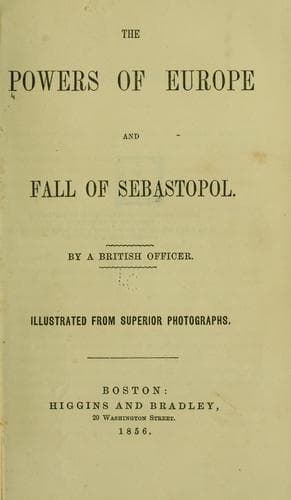
The Powers of Europe and Fall of SebastopolA British officer
History
The Powers of Europe and Fall of Sebastopol
A British officer
Crimean War, 1853-1856; Europe -- History -- 1789-1900
The loss of the allies was immense. Thirty thousand (30,000) men
were killed, wounded, or made prisoners. Of the latter were 19,000
Russians, and 6,000 Austrians, most of whom were wounded. Almost
the whole of their baggage fell into the hands of the victors. One
hundred and eighty pieces of cannon, four hundred covered wagons,
and forty-five standards, were taken, and the disorganization of the
combined forces was complete.
Twelve thousand French had been killed and wounded, making the
frightful sum total of that dreadful day’s carnage, 42,000 men.
On the 6th of Dec. an armistice was concluded at Austerlitz, and
Alexander sent to Berlin the Grand Duke Constantine to ascertain if
the Prussian King was prepared to join with him, according to the
principles which he had sworn to adhere to at the tomb of the great
Frederick, in the vigorous prosecution of the war. But the disaster
of Austerlitz had wrought a perfidious change in the policy of the
Prussian Cabinet.
An ambassador was sent to Napoleon to congratulate him upon his
success, and to propose a treaty. Napoleon broke out into a vehement
declamation against the policy of the Prussian Cabinet, and expressed
his determination now to turn his whole forces against them; but at
last yielding, the treaty was concluded, and a new alliance entered
into between Prussia and France, the former receiving as a reward
Hanover, with all the other continental dominions of his Britannic
Majesty.
During the year 1807, disagreements sprang up between France and
Prussia, which resulted at the battle of Jena, (Oct. 14th) in the
total discomfiture of the latter, and triumph of Napoleon, who now
became master of the whole country from the Rhine to the Vistula.
Passing the sanguinary contests of Eylau and Friedland, we come to
the treaty of Tilsit, the arrangement of which took place under
circumstances eminently calculated to impress the imagination of
mankind.
Certain misunderstandings having arisen between England and Russia,
and the latter power being somewhat crippled for the moment by
numerous defeats, an armistice was proposed by Alexander, and
accepted by Napoleon, on the 22d of June, which ended in the treaty
of Tilsit.
There was little difficulty in coming to an understanding, for France
had nothing to demand of Russia, except that she should close her
ports against England! Russia nothing to ask of France but that she
should withdraw her armies from Poland, and permit the Emperor to
pursue his long cherished projects of conquest in Turkey.
The armistice having been concluded, it was agreed that the two
Emperors should meet, to arrange, in a private conference, the
destinies of the world.
Public-domain text, read in full here on John Shaqi.
Reviews
Reviews
No reviews yet
Be the first to share your thoughts on this work.
Join the Discussion
Join the discussion
Sign in to leave a comment or review.
Sign InorCreate an account