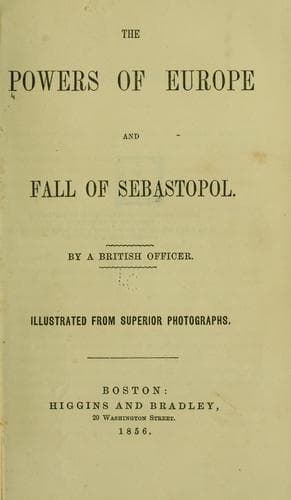
The Powers of Europe and Fall of SebastopolA British officer
History
The Powers of Europe and Fall of Sebastopol
A British officer
Crimean War, 1853-1856; Europe -- History -- 1789-1900
On came the foe in brilliant masses, pouring down at a canter into
the plain and on to the high road. Here one body of horse, 1,500
strong, rapidly wheeling to their left, charged down the road towards
Balaklava, against the single Highland regiment which there barred
the way, and which awaited their approach in a line two deep. At 800
yards the Turks, drawn up on the wings of the regiment, discharged
their muskets, and fled.
“Highlanders!” exclaimed Sir Colin Campbell, as he saw his men
wavering on being thus deserted, “if you don’t stand firm, not a man
of you will be left alive.” At 600 yards the regiment fired, but
with little effect, upon the Russian squadrons now advancing at a
gallop. The anxiety of the onlookers grew intense as they beheld that
immense body of charging cavalry within 150 yards of their Highland
line, when down again went the level line of Minié rifles, a steady
volley rang out, and the next instant the attacking squadrons were
seen wheeling off to the right and left in retreat.
Meanwhile the main body of the Russian cavalry swept on straight
across the plain, apparently with the design of carrying the
thinly-defended heights at a gallop. But a foe intervened of which
they did not make sufficient account. The instant they topped the
little eminence in front of the British cavalry, the trumpets of
the Heavy Brigade sounded the charge, and away went the brigade in
two lines, the Scots Greys and Enniskillens in front, led on by
Brigadier-General Scarlett. The Russians were likewise in two lines,
and more than twice as deep. The shock was terrific, but lasted only
for a moment. The handful of red-coats broke through the enemy,
scattering the first line right and left, and then charged the
second line, which came spurring up to the rescue. It was a fight of
heroes. The position of the Greys and Enniskilleners quickly became
one of imminent danger; for while cutting their way in splendid
style through their foes, the Russian first line rallied again,
and bore down upon their rear. God help them, they are lost! burst
from the Allied generals and on-lookers: when, like a thunder-bolt,
the 1st Royals and 4th and 5th Dragoon Guards, forming the British
second line, broke with one terrible assault upon the foe, cutting
through the line of rallying Russians as if it were pasteboard, and
then, falling upon the flank of the Russian line, disordered by the
terrible assault, put it to utter rout. A cheer burst from every
lip, and, in the enthusiasm, officers and men on the heights took
off their caps and shouted with delight. The loss to the British in
this splendid charge was very trifling. All danger to the Allied
position was now past. The enemy had made their rush, and failed. The
British and French divisions, arriving from before Sebastopol, began
to take up a position in the plain, and the Russians drawing back and
concentrating their forces, relinquished all the captured redoubts
save one.
Public-domain text, read in full here on John Shaqi.
Reviews
Reviews
No reviews yet
Be the first to share your thoughts on this work.
Elsewhere in the archive
Join the Discussion
Join the discussion
Sign in to leave a comment or review.
Sign InorCreate an account