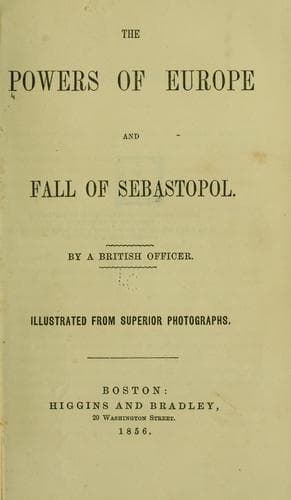
The Powers of Europe and Fall of SebastopolA British officer
History
The Powers of Europe and Fall of Sebastopol
A British officer
Crimean War, 1853-1856; Europe -- History -- 1789-1900
On the 2nd of December, a change took place in the views of the
Austrian cabinet, which was interpreted as favorable to the Western
Powers.
A treaty was signed at Vienna by the Earl of Westmoreland, the
Baron de Bourgueney, and Count Buol, as representatives of their
respective governments, of which the following are the principal
conditions:--The high contracting parties engage not to enter into
any engagement with Russia without deliberating in common. The
Emperor of Austria engages to defend the Principalities against any
attack by the Russians, and that nothing shall be done by his troops
to interfere with the free action of the Allies against the Russian
frontier. A commission, to consist of a plenipotentiary from each
government, with the addition of a Turkish commissioner, is to sit
at Vienna, to decide all questions arising out of the occupation. In
case of hostilities arising between Austria and Russia, an offensive
and defensive alliance is to be _de facto_ established between the
former and the Western Powers, and no suspension of hostilities will
be concluded without the agreement of all the three Powers.
The ratifications of this treaty were exchanged on the 14th.
The King of Prussia had played so vacillating a part that the
influence of that cabinet had ceased to be felt, and she was neither
consulted nor regarded.
Negotiations for peace have been set on foot, with some hope of
success, but as a basis for negotiation, Great Britain, France, and
Austria, unanimously determined to insist upon, and abide by, the
following four points:
_1st. The abolition of the Protectorate over the Danubian
Principalities, and the privileges of those provinces placed under
the collective guarantee of the contracting powers._
_2d. The free navigation of the mouths of the Danube secured
according to the principles established by the Congress of Vienna._
_3d. The revision of the Treaty of 13th July, 1841, in the interest
of the balance of power in Europe._
_4th. The abandonment, by Russia, of her claim to exercise an
official protectorate over the Christian subjects of the Porte
(to whatever rite they might belong) in consideration of the
Powers giving their mutual assistance to obtain from the Sultan
a confirmation and observance of the religious privileges of all
Christian communities._
A period of fourteen days was given Prince Gortschakoff in which to
communicate with his Imperial master.
In less than eight days, instead of the fourteen allowed him, the
Plenipotentiary of the Czar was instructed to negotiate a peace on
the minimum proposed.
Public-domain text, read in full here on John Shaqi.
Reviews
Reviews
No reviews yet
Be the first to share your thoughts on this work.
Elsewhere in the archive
Join the Discussion
Join the discussion
Sign in to leave a comment or review.
Sign InorCreate an account