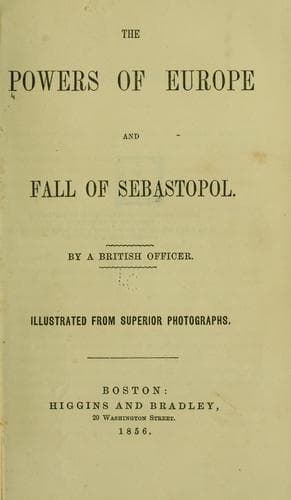
The Powers of Europe and Fall of Sebastopol — John Shaqi
The Powers of Europe and Fall of SebastopolA British officer
History
The Powers of Europe and Fall of Sebastopol
A British officer
Crimean War, 1853-1856; Europe -- History -- 1789-1900
The French ambassador left Vienna finally, on the 28th Feb., 1809,
and in April active hostilities broke out thus kindling again the
flames of war.
Warsaw, garrisoned by the French, was taken by the Austrians, at
which time occurred an event of significant importance.
In pursuing the Austrians, a courier was taken with despatches
from the Russian General Gortschakoff to the Austrian Arch-Duke,
congratulating him on the capture of Warsaw, and breathing a wish
that he might soon join his armies to the Austrian Eagles.
This letter was immediately forwarded to Napoleon, who remarked, “I
see, after all, I must make war upon Alexander.”
The Czar disavowed the letter, and attempted explanations, but a
breach was opened which was never again healed.
Austria endeavored to win Prussia to her side after the battle of
Aspern (unfavorable to Napoleon), and secret negotiations were
carried on. But the Prussian government replied to Austria’s
overtures, that they had every disposition to assist her, but could
not take part in the contest till the views of Russia in regard to it
were known.
In the meantime the struggle continued, and after a great number
of contests, in some of which Napoleon’s chances were desperate,
finally, on the 5th of July, 1809, was fought the celebrated battle
of Wagram, under the walls of Vienna, which resulted in victory to
Napoleon, though at so dear a price as almost to equal a defeat.
50,000 men were killed and wounded.
The peace of Vienna followed on the 14th of October, and was of so
humiliating a nature that it was received with marked disapprobation
by the Cabinet of St. Petersburg, and was attended with a most
important effect in widening the breach which was already formed
between the two Emperors.
The Turkish empire at this time was in a state of decay, and the
people, from the inefficiency of the government, and the constantly
recurring insurrections, in a state of misery.
But amid the general decay, the matchless situation of Constantinople
still attracted a vast concourse of inhabitants, and veiled under a
robe of beauty the decline of the Queen of the East.
This celebrated capital, the incomparable excellence of whose
situation attracted the eagle eye of Alexander, had long formed the
real object of discord between the Courts of Paris and St. Petersburg.
War had been formally declared by Russia against Turkey, in Jan.,
1807, in consequence of a dispute about the hospodars, or governors,
of Wallachia and Moldavia. Soon after, the conspiracy of the
Janizaries broke out against the reforms of the Sultan, assisting
materially Russia’s designs.
In the beginning of the year 1810 an _Imperial Ukase_ appeared,
annexing Moldavia and Wallachia, which for three years had been
occupied by their troops, to the Russian Empire, and declaring the
Danube, from the Austrian frontier to the Black Sea, the southern
European boundary of their mighty dominion.
Public-domain text, read in full here on John Shaqi.
Reviews
Reviews
No reviews yet
Be the first to share your thoughts on this work.
Join the Discussion
Join the discussion
Sign in to leave a comment or review.
Sign InorCreate an account