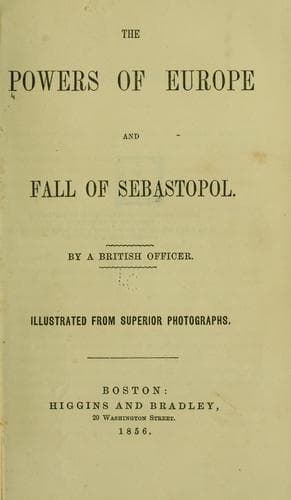
The Powers of Europe and Fall of SebastopolA British officer
History
The Powers of Europe and Fall of Sebastopol
A British officer
Crimean War, 1853-1856; Europe -- History -- 1789-1900
As a consequence of the downfall of Prussia, the neutrality of
Austria, and the accession to the confederacy of Alexander at Tilsit,
Napoleon was emboldened to attempt the carrying out of his long
cherished “_Continental System_” of combining all the Continental
States into one great alliance against England, and to compel them to
exclude the British Flag and British merchandise from their harbors.
It was at this time that he promulgated the famous _Berlin Decree_,
which declared the British Islands in a state of blockade,
and subjected all goods of British produce or manufacture, to
confiscation within his dominions, or those of the countries subject
to his control, and prohibited all vessels from entering any harbor,
which had touched at any British port.
As a retaliatory measure the celebrated _Orders in Council_ were
issued by the British Government (on the 11th Nov. 1807), which
proclaimed France and all the Continental States in a state of
blockade, and declared all vessels good prize, which should be bound
for any of their harbors, excepting such as had previously cleared
out _from_ or touched _at_ a British harbor.
This was followed on the 17th December, by the _Milan Decree_, which
declared that any vessel, of whatever nation, which shall have
submitted to be searched by British cruisers, shall be considered and
dealt with as English vessels, and every vessel of whatever nation,
coming _from_ or bound _to_ any British harbor, shall be declared
good prize.
England, being mistress of the seas, enforced with unfeeling rigor
her orders in council, entailing immense losses upon the commerce of
neutral States, but more particularly upon America, which ultimately
brought about the war between herself and the great Republic; while
France, comparatively powerless on the ocean, invoked the aid of
privateers and seized upon all British persons and property within
her grasp.
Since the defeat of Austria at Austerlitz, in 1805, the Cabinet of
Vienna had adhered with cautious prudence to a system of neutrality.
Still the Imperial Government had been successfully at work to fill
up the ranks of their decimated armies, and to place themselves again
in a position of strength.
Napoleon was no sooner informed of these military preparations than
he demanded an explanation of their import.
Austria made professions of pacific intentions, but still continued
to arm herself; the war in Spain, which Napoleon had at this time on
his hands, leading her to suppose that he would not for so slight a
cause undertake another contest.
In the meantime, the wily Metternich, Austrian Ambassador at Paris,
was endeavoring to maintain apparently amicable relations with the
French government, while every effort was made to induce Alexander to
join with Austria; but the Czar had pledged his word to Napoleon, and
was not inclined to break a personal engagement of such importance.
Public-domain text, read in full here on John Shaqi.
Reviews
Reviews
No reviews yet
Be the first to share your thoughts on this work.
Join the Discussion
Join the discussion
Sign in to leave a comment or review.
Sign InorCreate an account