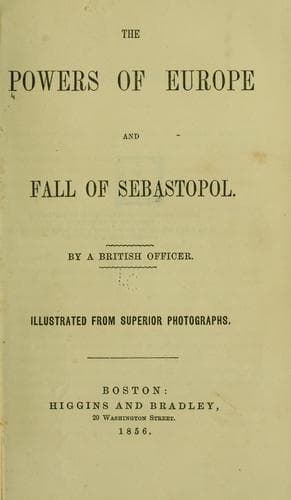
The Powers of Europe and Fall of SebastopolA British officer
History
The Powers of Europe and Fall of Sebastopol
A British officer
Crimean War, 1853-1856; Europe -- History -- 1789-1900
In addition to the whole French army, numbers flocked in from
the country to share in the general license; furniture of the
most precious description, splendid jewellery, Indian and Turkish
stuffs, stores of wine and brandy, gold and silver plate, rich
furs, gorgeous trappings of silk and satin were spread about in
promiscuous confusion, and became the prey of the least intoxicated
among the multitude. A frightful tumult succeeded to the stillness
which had reigned in the city when the troops first entered. The
French soldiers, tormented by hunger and thirst, and loosened from
all discipline by the horrors which surrounded them, often rushed
headlong into the burning edifices to ransack their cellars for
wines and spirits, and beneath the ruins great numbers miserably
perished, the victims of intemperance and the surrounding fire.
Napoleon abandoned the Kremlin on the evening of the 16th. Early on
the following morning, casting a melancholy look to the burning city,
which now filled half the heavens with its flames, he exclaimed after
a long silence, “This sad event is the presage of a long train of
disasters.”
Thus vanished the hopes of those indefatigable soldiers who had
endured so much, and fought so well. To reach the fabulous city whose
domes and minarets were now fallen--had been the dream of their
ambition--the goal which once attained, would give rest and food to
their weariness and hunger.
Thus Napoleon found himself possessed of a heap of burning ruins
without food for his famishing soldiers and horses.
All negotiations with the Russian authorities having failed, a
retreat was decided upon, and the Emperor left Moscow on the 19th
of October, at the head of 105,000 combatants. The disasters of that
retreat are too well known to require recapitulation.
Suffice it to say that the survivors of the French army, who entered
Russia 500,000 strong, were but 20,000. The total loss of the
campaign, in killed, prisoners, died from cold, fatigue, and famine,
was over 450,000. And on the 13th of December, the wretched remnant
of the French army passed the bridge of the Niemen. The losses of the
Russians were also so great that at the end of the campaign not above
30,000 men could be assembled around the head-quarters of the Emperor
Alexander.
On the 10th Dec., early in the morning, a travelling carriage in
great haste drove into the Hotel d’Angleterre, at Warsaw. It was a
small travelling britschka placed without wheels on a coarse sledge,
made of four pieces of rough fir-wood, which had been almost dashed
to pieces in entering the gateway. The travellers were ushered into a
small dark apartment, with the windows half-shut, and in a corner of
which a servant girl strove in vain to light a fire with green damp
billets of wood, which, after kindling for a moment, gradually went
out, leaving those in the apartment to shiver with cold during three
hours of earnest conversation.
Public-domain text, read in full here on John Shaqi.
Reviews
Reviews
No reviews yet
Be the first to share your thoughts on this work.
Join the Discussion
Join the discussion
Sign in to leave a comment or review.
Sign InorCreate an account