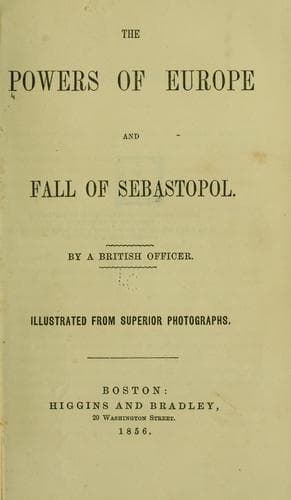
The Powers of Europe and Fall of SebastopolA British officer
History
The Powers of Europe and Fall of Sebastopol
A British officer
Crimean War, 1853-1856; Europe -- History -- 1789-1900
The travellers were Napoleon and his friend Caulaincourt, who five
days previously had bidden the remnant of his retreating army, in
Russia, an affectionate farewell, and started for Paris.
At length, it being announced that the carriage was ready, they
mounted the sledge, and were soon lost in the gloom of a Polish
winter. Outstripping his couriers in speed, on the 18th Dec., at 11
at night, the Emperor arrived at the Tuileries, before the Imperial
government was even aware that he had quitted the army. And early
next morning, while the streets of Paris were yet vacant, he was
buried in state papers, investigating and arranging the disorganized
affairs of the empire.
THE GRAND ALLIANCE.
Napoleon’s power being no longer dreaded, Prussia became disaffected,
and on the 28th of February, 1813, entered into an alliance offensive
and defensive with Russia, called, _the treaty of Kalisch_, which was
the foundation stone of that grand alliance which finally overthrew
the French Emperor. Great efforts were made to induce Saxony to join
the league; but she remained permanently attached to the fortunes of
Napoleon.
Meanwhile Alexander despatched a confidential agent to Vienna, in
order to sound the Imperial Cabinet on the prospect of a European
alliance against France, and it was soon after discovered that,
notwithstanding Austria’s professed friendship for Napoleon, there
was a secret understanding existing between the Cabinets of St.
Petersburg and Vienna, as also with the King of Prussia.
The accession of Sweden was received on the 3d of March.
During the month of April a convention took place between Great
Britain, Russia, and Prussia, when England, in addition to the
immense supplies of arms and military stores which she was
furnishing, agreed to advance two millions sterling ($10,000,000) to
sustain the operations of the Prince Royal of Sweden in the north of
Germany, and a like sum to enable Russia and Prussia to keep up their
vast armaments in Saxony.
On the 14th of June another treaty was signed stipulating that
England should pay to Prussia, for the six remaining months of the
year, about £700,000, in consideration of which, the latter was to
keep in the field an army of 80,000 men.
By another treaty, signed the day after, between Russia and Great
Britain, it was stipulated that Great Britain should pay to its
Emperor, till January, 1814, £1,333,334 in monthly instalments, by
which he was to maintain 160,000 men in the field, independent of
the garrisons of strong places. On the 27th of July Austria joined
the alliance (against their Emperor’s son-in-law), England agreeing
to pay her equal to one million sterling, in the event of her taking
part in the war; thus completing the formidable alliance of Great
Britain, Russia, Prussia, Austria, and Sweden.
Public-domain text, read in full here on John Shaqi.
Reviews
Reviews
No reviews yet
Be the first to share your thoughts on this work.
Join the Discussion
Join the discussion
Sign in to leave a comment or review.
Sign InorCreate an account