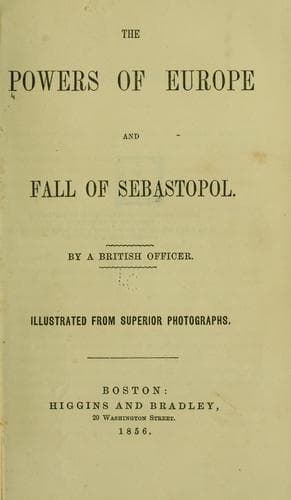
The Powers of Europe and Fall of SebastopolA British officer
History
The Powers of Europe and Fall of Sebastopol
A British officer
Crimean War, 1853-1856; Europe -- History -- 1789-1900
Including 80,000 Austrians, destined to act in the north of Italy,
and a hundred and forty thousand British, Portuguese, and Spaniards,
who, under the guidance of Wellington, were assailing the south,
the whole force of the allies formed a mass of _a million and
twenty-eight thousand men_, which was prepared to act against the
French empire.
The French army was so reduced, that the Emperor could not, with
the utmost exertion, reckon upon more than 350,000 men to defend
the frontiers of his widespread dominions. Of these, 100,000 were
blockaded in Hamburg and on the Oder, 50,000 were maintaining a
painful defensive against the Austrians in the north of Italy, and
100,000 were struggling against the superior armies of Wellington on
the Spanish frontiers. So that the real army which the Emperor had
at his disposal to resist the invasion on the Rhine did not exceed
110,000.
On the 31st of Dec., 1813, the united and victorious allies crossed
that river. Numerous battles ensued. At length a conference was held,
and the allied sovereigns offered to conclude peace, and recognize
Napoleon as Emperor of France, on certain conditions, which would
have left him an empire greater than that over which his nephew now
reigns. This did not, however, satisfy his ambition. The overtures
were refused, and on the 30th of March, 1814, after numerous
sanguinary engagements, and the storming of the city, the allies
entered Paris, which had been forced to capitulate.
On the 11th of April Napoleon signed his abdication at Fontainbleau,
and on the 28th of the same month, at eight at night, set sail from
Frejus for the island of Elba, on board the English frigate “_The
Undaunted_.”
On the 1st of March, 1815, having escaped from Elba, he again entered
France, with a few hundred men, and was everywhere received with
acclamation and shouts of joy, which resounding throughout the land,
were echoed to the Tuileries, and caused such consternation, that the
court became alarmed, and at midnight, on the 19th, Louis XVIII. and
the royal family, left Paris, and escaped into Belgium, while at nine
o’clock in the evening of the next day Napoleon entered the vacated
palace.
The allies became alarmed, and on the 25th of March, Russia, Prussia,
Austria, and Great Britain, concluded a treaty, engaging to unite
their forces against Bonaparte, with a secret stipulation that the
high contracting parties should not lay down their arms till the
complete destruction of Napoleon had been effected. Such, however,
was the poverty at this time of the Continental powers, that
they were unable to put their armies in motion without pecuniary
assistance. And a treaty was entered into at Vienna on the 30th
of April, by which England agreed to furnish Austria, Russia, and
Prussia, the necessary means for the prosecution of the war, and
actually paid to foreign powers during the year above £11,000,000
($55,000,000).
Public-domain text, read in full here on John Shaqi.
Reviews
Reviews
No reviews yet
Be the first to share your thoughts on this work.
Join the Discussion
Join the discussion
Sign in to leave a comment or review.
Sign InorCreate an account