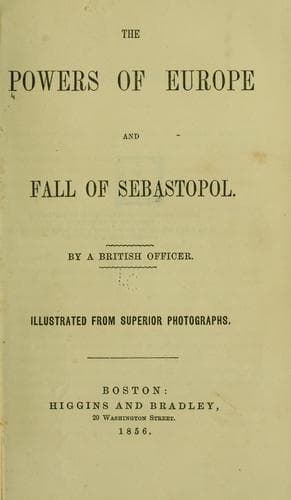
The Powers of Europe and Fall of SebastopolA British officer
History
The Powers of Europe and Fall of Sebastopol
A British officer
Crimean War, 1853-1856; Europe -- History -- 1789-1900
Napoleon left Paris on the morning of the 12th of June, and joined
his army, which had been concentrated near the frontiers of Belgium,
on the 13th. The returns on the evening of the 14th, gave 122,400
men under arms, and at day-break on the 15th his army crossed the
frontier.
Various conflicts ensued between different portions of his forces,
directed to different points, and those of the allies, who, under
Wellington, were in occupation of Brussels.
At length, the morning of the 18th dawned upon the battle field of
Waterloo, and its evening witnessed the annihilation of the French
army, and flight of Napoleon.
On the 17th of July, the victorious allies, headed by Wellington, a
second time entered Paris; and on the following day, Louis XVIII.
made his public entry into that gay capital, escorted by the national
guard.
On the 29th of June, Napoleon had left Malmaison (the home of his
lost Josephine) for Rochefort, arriving at that harbor on the 3d of
July, from whence he was anxious to embark for America.
But the blockade of English cruisers was so vigilant that there was
no possible chance of avoiding them.
[Illustration: NAPOLEON AND JOSEPHINE]
Under these circumstances, he at length adopted the resolution of
throwing himself upon the generosity of the British government; and
on the 14th of July embarked on board the “Bellerophon,” which set
sail immediately for England,--and Napoleon looked for the last time
upon the receding shores of that land which had been the home of his
greatness.
CHAPTER II.
Origin of the War in the Peninsula--Siege of Saragossa--Murderous
Character of the War--Success of the French in Portugal--Battle of
Rolica--Battle of Vimiero--Convention of Cintra--The French
evacuate Portugal--Preparations of Napoleon for another Campaign--He
subdues the Country, and enters Madrid--Address to the Spanish
People--Napoleon recalled by the War with Austria--Soult and
Ney intrusted with the Command of the French Army in Spain--Retreat
of Sir John Moore--Battle of Corunna--Death of Sir John Moore--The
British Army sail for England.
Before entering into a particular account of the battles in which I
was myself an actor, it might not be uninteresting to my readers to
take a hasty survey of the war which was now raging in the Peninsula,
and the causes which led to British intervention. In doing this, I
can, of course, in so small a work, only allude to its principal
events, and relate some anecdotes, interesting, as well from their
authenticity, as from the patriotism of which they were such bright
examples.
Public-domain text, read in full here on John Shaqi.
Reviews
Reviews
No reviews yet
Be the first to share your thoughts on this work.
Join the Discussion
Join the discussion
Sign in to leave a comment or review.
Sign InorCreate an account