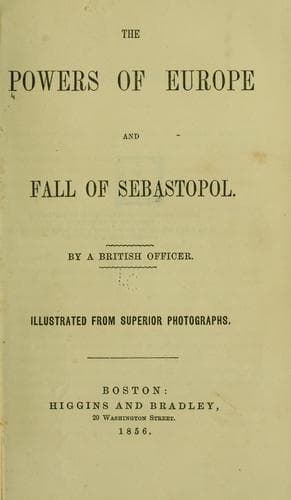
The Powers of Europe and Fall of SebastopolA British officer
History
The Powers of Europe and Fall of Sebastopol
A British officer
Crimean War, 1853-1856; Europe -- History -- 1789-1900
Charles IV., a descendant of the Spanish Bourbons, in 1807, occupied
the throne of Spain. He was feeble in mind, impotent in action, and
extremely dissolute in his habits. Writing to Napoleon, he gives an
account of himself which must have filled with contempt the mind of
the hard-working emperor for the imbecile king who thus disgraced a
throne. “Every day,” says he, “winter as well as summer, I go out to
shoot, from morning till noon. I then dine, and return to the chase,
which I continue till sunset. Manuel Godoy then gives me a brief
account of what is going on, and I go to bed, to recommence the same
life on the morrow.” His wife, Louisa, was a shameless profligate.
She had selected, from the body-guard of the king, a young soldier,
named Godoy, as her principal favorite; and had freely lavished on
him both wealth and honors. He was known as the Prince of Peace. A
favorite of the king, as well as queen, the realm was, in reality,
governed by him. Ferdinand, Prince of the Asturias, and heir to the
throne, hated this favorite. Weak, unprincipled, and ambitious,
unwilling to wait until the crown should become his by inheritance,
it is said that he concerted a scheme to remove both his parents
by poison. He was arrested, and imprisoned. Natural affection was
entirely extinct in the bosoms of his parents. Louisa, speaking of
her son, said that “he had a mule’s head and a tiger’s heart;” and
history informs us that if injustice is done here, it is only to the
tiger and mule. Both king and queen did all they could to cover his
name with obloquy, and prepare the nation for his execution. But the
popular voice was with Ferdinand. The rule of the base-born favorite
could not be tolerated by the Spanish hidalgos; and the nation,
groaning under the burdens that the vices and misrule of Charles
had brought upon them, looked with hope to the youth, whose very
abandonment had excited an interest in his favor. From the depths of
his prison he wrote to Napoleon, imploring his aid, and requesting an
alliance with his family. Charles, too, invoked the assistance “of
the hero destined by Providence to save Europe and support thrones.”
A secret treaty was concluded between the emperor and Charles, whose
object was nominally the conquest of Portugal; and thus French
troops were brought to Madrid. A judicial investigation was held on
the charge against Ferdinand, which ended in the submission of that
prince to his parents. But the intrigues of the two parties still
continued. In March, 1808, hatred of Godoy, and contempt of the king,
had increased to such a degree, that the populace of Madrid could no
longer be controlled. The palace of the Prince of Peace was broken
open and sacked. The miserable favorite, allowed scarcely a moment’s
warning of the coming storm, had barely time to conceal himself
beneath a pile of old mats, in his garret. Here, for thirty-six
hours, he lay, shivering with terror and suffering. Unable longer to
Public-domain text, read in full here on John Shaqi.
Reviews
Reviews
No reviews yet
Be the first to share your thoughts on this work.
Join the Discussion
Join the discussion
Sign in to leave a comment or review.
Sign InorCreate an account