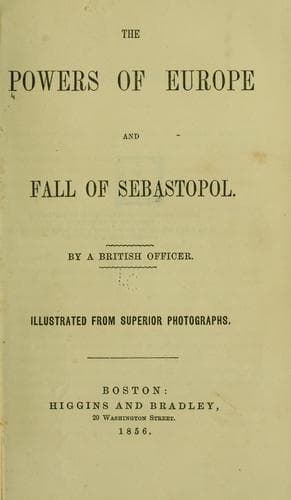
The Powers of Europe and Fall of SebastopolA British officer
History
The Powers of Europe and Fall of Sebastopol
A British officer
Crimean War, 1853-1856; Europe -- History -- 1789-1900
“The fate of the East depends upon yon petty town,” was the
exclamation of Bonaparte to Murat, as he pointed towards Acre, which
even his military genius was unable to subdue. Repeated and desperate
assaults proved that the consequence which he attached to the taking
of it was as great as the words expressed. The imagination reverts
from the position of the army of Egypt before that oriental city,
and rapidly traversing the events of succeeding history, runs down
to the position of the army of the successor of Bonaparte, and of
his English and Turkish allies, who, on nearly the precise parallel
of longitude, are unitedly engaged in besieging one of the first
strongholds of Europe.
In recounting some of the great events of the times which have
filled the world with their grandeur, and whose present and future
place in history overshadows the preceding ages, a rapid _resumé_ of
the situation of Europe, just previous to and at the commencement of
the great drama, may be useful, and serve to recall facts and events
which may to the general reader have been known but forgotten.
One who stands amid the gardens and grounds of Versailles, and
contemplates the enormous luxury and expenditure of its builder,
while he recalls his vast wars, his policy, and his intrigues, can
better understand the declaration of Louis XIV. to his assembled
parliament. “The State! I am the State!” And such an observer can
also discover the truth of that statement, that it was that builder
who laid the foundations of the French Revolution with the stones of
Versailles. The keen sagacity of the polite Chesterfield could detect
that approaching revolution a quarter of a century before it took
place; and his remarkable prediction shows how rapidly the signs of
the gathering storm must have accumulated in the years succeeding the
Augustan age of France. The energies of the nation had been devoted
to the service and pleasure of the monarch; they now began to be
directed to their proper end, the examination of their own interests.
From the theatre and the pulpit the genius of the French people
hurried precipitately into morals and politics, a sudden revolution
took place in the minds of all, and the conflict it produced lasted
during a whole century.
The exclusive privileges of the aristocracy, who monopolised every
official position, and who alone were eligible to rank in the army,
choked the development of the great body of the people; and
while they consumed the revenues of the State they were in a great
measure exempt from taxation. Cradled in the luxury of courts, the
aristocracy were sunk in vice and effeminacy. And they looked upon
the great body of the people as only a necessary appendage to a
government in which they had neither right nor control.
Public-domain text, read in full here on John Shaqi.
Reviews
Reviews
No reviews yet
Be the first to share your thoughts on this work.
Join the Discussion
Join the discussion
Sign in to leave a comment or review.
Sign InorCreate an account