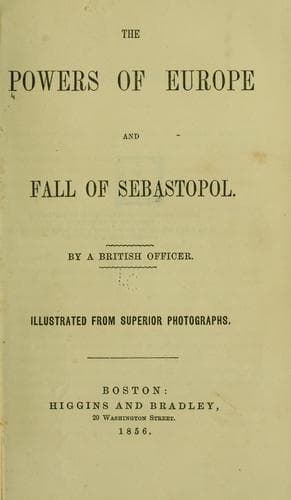
The Powers of Europe and Fall of SebastopolA British officer
History
The Powers of Europe and Fall of Sebastopol
A British officer
Crimean War, 1853-1856; Europe -- History -- 1789-1900
In the most martial nation of Europe the private soldier could not,
by the greatest daring or genius, elevate himself, because only the
aristocracy could obtain rank. The effects of the opposite system
were afterwards seen with Napoleon, who boasted that he conquered
Europe with the bivouac; with generals raised from the ranks.
The oppressions of the feudal tenure in France exceeded belief; the
people were even obliged to grind corn at the landlord’s mill, press
their grapes at his press, and bake their bread at his oven on his
own terms.
The fermentation which had long been going on in the public mind;
“the revolt against eighteen centuries of oppression” began to
develop itself rapidly. Yet the monopolizers of all the national
rights continued to dispute for a worn out authority. The court,
careless and tranquil in the midst of the struggle, were wasting
the property of the people while surrounded by the most frightful
disorders. When it was told to the effeminate and dissolute Louis XV.
that the nation could not suffer much longer, he characteristically
said, “Never mind, if it last my time it is sufficient for me!” Such
was the eighteenth century.
It was during the years 1787 and ’88, that the French nation first
conceived the idea of passing from theory to practice. The weak and
vacillating Louis XVI., the least fitted of all men to guide the
destinies of a nation in the throes of political convulsion, had
successively tried ministry after ministry, and one expedient after
the other; yet the ship of state was swiftly approaching the vortex
of the whirlpool in which it had entered.
Public-domain text, read in full here on John Shaqi.
Reviews
Reviews
No reviews yet
Be the first to share your thoughts on this work.
Join the Discussion
Join the discussion
Sign in to leave a comment or review.
Sign InorCreate an account