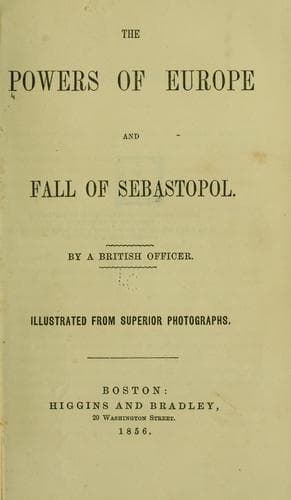
The Powers of Europe and Fall of Sebastopol — John Shaqi
The Powers of Europe and Fall of SebastopolA British officer
History
The Powers of Europe and Fall of Sebastopol
A British officer
Crimean War, 1853-1856; Europe -- History -- 1789-1900
England, like other monarchies, had slumbered on contented and
prosperous, and for the most part inglorious, during the eighteenth
century. A great writer observed, that while America was doubling
her population every twenty-five years, Europe was lumbering on with
an increase, which would hardly arrive at the same result in five
hundred; and Gibbon lamented that the age of interesting incidents
was past, and that the modern historian would never again have to
record the moving events, and dismal catastrophes of ancient story.
Such were the anticipations of the greatest men on the verge of a
period that was to usher in a new Cæsar, and to be illustrated by
an Austerlitz and a Trafalgar, a Wellington and a Waterloo; and the
human race, mowed down by unparalleled wars, was to spring up again
with an elasticity before unknown. William Pitt was the great Prime
Minister of England at this time, and modern history cannot exhibit a
statesman more fertile in resources, and whose expedients seemed as
exhaustless as his great abilities. Fox and Burke, each distinguished
by a high order of intellect, filled the British Parliament with
their reasoning and eloquence.
The great Austrian empire contained at that time nearly 25,000,000
of inhabitants, with a revenue of 95,000,000 florins, and numbered
the richest and most fertile districts of Europe among its provinces.
The wealth of Flanders, the riches of Lombardy, and the valor of
the Hungarians added to the strength of the Empire. Her armies
had acquired immortal renown in the wars of Maria Theresa. At the
commencement of the war, her force amounted to 240,000 infantry,
35,000 cavalry, and 100,000 artillery. Her court, the most
aristocratic in Europe, was strongly attached to old institutions,
and the marriage of Maria Antoinette to Louis XVI. gave the Austrian
court a family interest in the affairs which preceded and followed
the French Revolution.
The military strength of Prussia, raised to the highest pitch by
the genius of Frederic the Great, had rendered her one of the first
powers of Europe; her army of 165,000 strong was in the highest state
of discipline and equipment, and by a system of organization the
whole youth of the kingdom were compelled to serve a limited number
of years in the army, so that she had within herself an inexhaustible
reserve of men trained to arms. Her cavalry was the finest in Europe.
Public-domain text, read in full here on John Shaqi.
Reviews
Reviews
No reviews yet
Be the first to share your thoughts on this work.
Join the Discussion
Join the discussion
Sign in to leave a comment or review.
Sign InorCreate an account