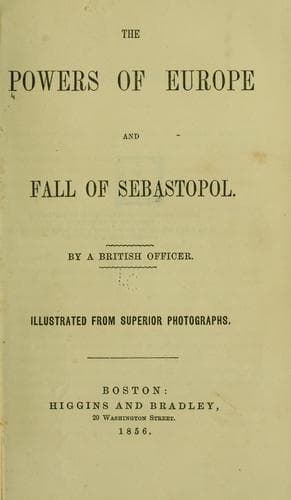
The Powers of Europe and Fall of SebastopolA British officer
History
The Powers of Europe and Fall of Sebastopol
A British officer
Crimean War, 1853-1856; Europe -- History -- 1789-1900
At length, on the 20th of April, 1792, oppressed with the solemnity
and grandeur of the occasion, the declaration of war against
Austria was received by the National Assembly of France in solemn
silence. Thus commenced the greatest, the most bloody, and the most
interesting war which has agitated mankind since the fall of the
Roman Empire. Rising from feeble beginnings, it at length involved
the world in its conflagration; rousing the passions of every class,
it brought unheard of armies into the field; and it was carried on
with a degree of exasperation unknown in modern times. “A revolution
in France,” says Napoleon, “is always followed, sooner or later, by a
revolution in Europe.” Situated in the centre of modern civilization,
it has in every age communicated the impulse of its own changes to
the adjoining states Thus, the great changes which had taken place
in France had excited all Europe, and spread the utmost alarm in all
her monarchies.
Austria, Russia, Prussia, and England were at that period, as now,
the great powers of Europe, and they were the principal actors in the
desperate struggle which ensued. They were in a situation capable
of great exertion; years of repose had fitted them to enter upon a
gigantic war. England, although she had lost one empire in the west,
had gained another in the east; and the wealth of India began to pour
into her bosom. The public funds had risen from 57, at the close of
the American War, to 99. Her army consisted of 32,000 men in the
British Isles, besides an equal force in the East and West Indies;
but these forces were rapidly augmented after the commencement of
the war, and before 1796, the regular force amounted to 206,000 men,
including 42,000 militia. Yet experience proves that Britain could
never collect above 40,000 men upon any one point of the continent of
Europe. But her real strength consisted in her great wealth, in the
public spirit and energy of her people, and in a fleet of 150 ships
of the line, which commanded the seas.
Public-domain text, read in full here on John Shaqi.
Reviews
Reviews
No reviews yet
Be the first to share your thoughts on this work.
Join the Discussion
Join the discussion
Sign in to leave a comment or review.
Sign InorCreate an account