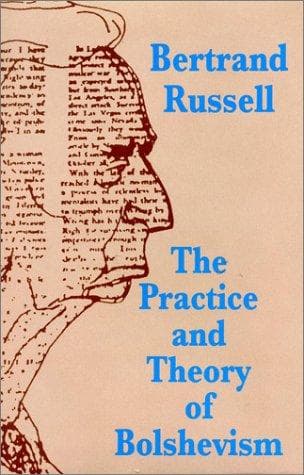
The Practice and Theory of BolshevismRussell, Bertrand
Religion
The Practice and Theory of Bolshevism
Russell, Bertrand
Communism -- Soviet Union -- History; Soviet Union -- Social conditions
For my part, after weighing this theory carefully, and after admitting
the whole of its indictment of _bourgeois_ capitalism, I find myself
definitely and strongly opposed to it. The Third International is an
organization which exists to promote the class-war and to hasten the
advent of revolution everywhere. My objection is not that capitalism
is less bad than the Bolsheviks believe, but that Socialism is less
good, not in its best form, but in the only form which is likely to be
brought about by war. The evils of war, especially of civil war, are
certain and very great; the gains to be achieved by victory are
problematical. In the course of a desperate struggle, the heritage of
civilization is likely to be lost, while hatred, suspicion, and
cruelty become normal in the relations of human beings. In order to
succeed in war, a concentration of power is necessary, and from
concentration of power the very same evils flow as from the capitalist
concentration of wealth. For these reasons chiefly, I cannot support
any movement which aims at world revolution. The damage to
civilization done by revolution in one country may be repaired by the
influence of another in which there has been no revolution; but in a
universal cataclysm civilization might go under for a thousand years.
But while I cannot advocate world revolution, I cannot escape from the
conclusion that the Governments of the leading capitalist countries
are doing everything to bring it about. Abuse of our power against
Germany, Russia, and India (to say nothing of any other countries) may
well bring about our downfall, and produce those very evils which the
enemies of Bolshevism most dread.
The true Communist is thoroughly international. Lenin, for example, so
far as I could judge, is not more concerned with the interests of
Russia than with those of other countries; Russia is, at the moment,
the protagonist of the social revolution, and, as such, valuable to
the world, but Lenin would sacrifice Russia rather than the
revolution, if the alternative should ever arise. This is the orthodox
attitude, and is no doubt genuine in many of the leaders. But
nationalism is natural and instinctive; through pride in the
revolution, it grows again even in the breasts of Communists. Through
the Polish war, the Bolsheviks have acquired the support of national
feeling, and their position in the country has been immensely
strengthened.
Public-domain text, read in full here on John Shaqi.
Reviews
Reviews
No reviews yet
Be the first to share your thoughts on this work.
Join the Discussion
Join the discussion
Sign in to leave a comment or review.
Sign InorCreate an account