The Practice and Theory of Bolshevism — John Shaqi
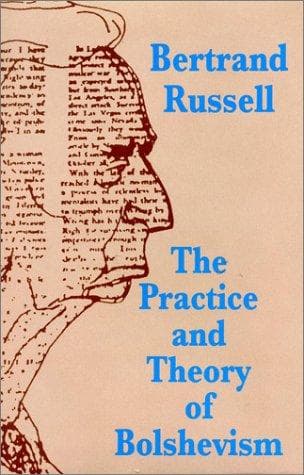
The Practice and Theory of BolshevismRussell, Bertrand
Religion
The Practice and Theory of Bolshevism
Russell, Bertrand
Communism -- Soviet Union -- History; Soviet Union -- Social conditions
I said that this state of affairs may in the long run be bad for art,
but the contrary may equally well prove to be the truth. It is of
course discouraging and paralysing to the old-style artist, and it is
death to the old individual art which depended on subtlety and oddity
of temperament, and arose very largely from the complicated psychology
of the idle. There it stands, this old art, the purest monument to the
nullity of the art-for-art's-sake doctrine, like a rich exotic plant
of exquisite beauty, still apparently in its glory, till one perceives
that the roots are cut, and that leaf by leaf it is gradually fading
away.
But, unlike the Puritans in this respect, the Bolsheviks have not
sought to dig up the roots, and there are signs that the paralysis is
merely temporary. Moreover, individual art is not the only form, and
in particular the plastic arts have shown that they can live by mass
action, and flourish under an intolerant faith. Communist artists of
the future may erect public buildings surpassing in beauty the
mediaeval churches, they may paint frescoes, organize pageants, make
Homeric songs about their heroes. Communist art will begin, and is
beginning now, in the propaganda pictures, and stories such as those
designed for peasants and children. There is, for instance, a kind of
Rake's Progress or "How she became a Communist," in which the Entente
leaders make a sorry and grotesque appearance. Lenin and Trotsky
already figure in woodcuts as Moses and Aaron, deliverers of their
people, while the mother and child who illustrate the statistics of
the maternity exhibition have the grace and beauty of mediaeval
madonnas. Russia is only now emerging from the middle ages, and the
Church tradition in painting is passing with incredible smoothness
into the service of Communist doctrine. These pictures have, too, an
oriental flavour: there are brown Madonnas in the Russian churches,
and such an one illustrates the statistics of infant mortality in
India, while the Russian mother, broad-footed, in gay petticoat and
kerchief, sits in a starry meadow suckling her baby from a very ample
white breast. I think that this movement towards the Church tradition
may be unconscious and instinctive, and would perhaps be deplored by
many Communists, for whom grandiose bad Rodin statuary and the crudity
of cubism better express what they mean by revolution. But this
revolution is Russian and not French, and its art, if all goes well,
should inevitably bear the popular Russian stamp. It is would-be
primitive and popular art that is vulgar. Such at least is the
reflection engendered by an inspection of Russian peasant work as
compared with the spirit of _Children's Tales_.
Public-domain text, read in full here on John Shaqi.
Reviews
Reviews
No reviews yet
Be the first to share your thoughts on this work.
Join the Discussion
Join the discussion
Sign in to leave a comment or review.
Sign InorCreate an account