The Practice and Theory of Bolshevism — John Shaqi
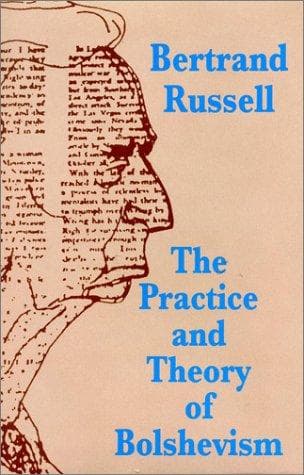
The Practice and Theory of BolshevismRussell, Bertrand
Religion
The Practice and Theory of Bolshevism
Russell, Bertrand
Communism -- Soviet Union -- History; Soviet Union -- Social conditions
It may be all to the good that there should be fewer professional
artists, since some of the finest work has been done by men and groups
of men to whom artistic expression was only a pastime. They were not
hampered by the solemnity and reverence for art which too often
destroy the spontaneity of the professional. Indeed a revival of this
attitude to art is one of the good results which may be hoped for from
a Communist revolution in a more advanced industrial community. There
the problem of education will be to stimulate the creative impulses
towards art and science so that men may know how to employ their
leisure hours. Work in the factory can never be made to provide an
adequate outlet. The only hope, if men are to remain human beings
under industrialism, is to reduce hours to the minimum. But this is
only possible when production and organization are highly efficient,
which will not be the case for a long time in Russia. Hence not only
does it appear that the number of artists will grow less, but that the
number of people undamaged in their artistic impulses and on that
account able to create or appreciate as amateurs is likely to be
deplorably small. It is in this damaging effect of industry on human
instinct that the immediate danger to art in Russia lies.
The effect of industry on the crafts is quite obvious. A craftsman who
is accustomed to work with his hands, following the tradition
developed by his ancestors, is useless when brought face to face with
a machine. And the man who can handle the machine will only be
concerned with quantity and utility in the first instance. Only
gradually do the claims of beauty come to be recognized. Compare the
modern motor car with the first of its species, or even, since the
same law seems to operate in nature, the prehistoric animal with its
modern descendant. The same relation exists between them as between
man and the ape, or the horse and the hipparion. The movement of life
seems to be towards ever greater delicacy and complexity, and man
carries it forward in the articles that he makes and the society that
he develops. Industry is a new tool, difficult to handle, but it will
produce just as beautiful objects as did the mediaeval builder and
craftsman, though not until it has been in being for a long time and
belongs to tradition.
Public-domain text, read in full here on John Shaqi.
Reviews
Reviews
No reviews yet
Be the first to share your thoughts on this work.
Join the Discussion
Join the discussion
Sign in to leave a comment or review.
Sign InorCreate an account