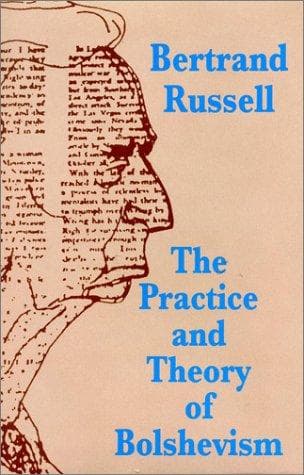
The Practice and Theory of BolshevismRussell, Bertrand
Religion
The Practice and Theory of Bolshevism
Russell, Bertrand
Communism -- Soviet Union -- History; Soviet Union -- Social conditions
Cannon shots announce the breaking of the blockade against
Soviet Russia, and the victory of the World Proletariat. The
Red Army returns from the front, and passes in triumphant
review before the leaders of the Revolution. At their feet lie
the crowns of kings and the gold of the bankers. Ships draped
with flags are seen carrying workers from the west. The
workers of the whole world, with the emblems of labour, gather
for the celebration of the World Commune. In the heavens
luminous inscriptions in different languages appear, greeting
the Congress: "Long live the Third International! Workers of
the world, unite! Triumph to the sounds of the hymn of the
World Commune, the 'International'."
Even so glowing an account, however, hardly does it justice. It had
the pomp and majesty of the Day of Judgment itself. Rockets climbed
the skies and peppered them with a thousand stars, fireworks blazed on
all sides, garlanded and beflagged ships moved up and down the river,
chariots bearing the emblems of prosperity, grapes and corn, travelled
slowly along the road. The Eastern peoples came carrying gifts and
emblems. The actors, massed upon the steps, waved triumphant hands,
trumpets sounded, and the song of the International from ten thousand
throats rose like a mighty wave engulfing the whole.
Though the end of this drama may have erred on the side of the
grandiose, this may perhaps be forgiven the organizers in view of the
occasion for which they prepared it. Nothing, however, could detract
from the beauty and dramatic power of the opening and of many of the
scenes. Moreover, the effects obtained by movement in the mass were
almost intoxicating. The first entrance of the masses gave a sense of
dumb and patient force that was moving in the extreme, and the
frenzied delight of the dancing crowd at the victory of the French
_communards_ stirred one to ecstasy. The pageant lasted for five hours
or more, and was as exhausting emotionally as the Passion Play is said
to be. I had the vision of a great period of Communist art, more
especially of such open-air spectacles, which should have the grandeur
and scope and eternal meaning of the plays of ancient Greece, the
mediaeval mysteries, or the Shakespearean theatre. In building,
writing, acting, even in painting, work would be done, as it once was,
by groups, not by one hand or mind, and evolution would proceed slowly
until once again the individual emerged from the mass.
In considering Education under the Bolshevik regime, the same two
factors which I have already dealt with in discussing art, namely
industrial development and the communist doctrine, must be taken into
account. Industrial development is in reality one of the tenets of
Communism, but as it is one which in Russia is likely to endanger the
doctrine as a whole I have thought it better to consider it as a
separate item.
Public-domain text, read in full here on John Shaqi.
Reviews
Reviews
No reviews yet
Be the first to share your thoughts on this work.
Join the Discussion
Join the discussion
Sign in to leave a comment or review.
Sign InorCreate an account