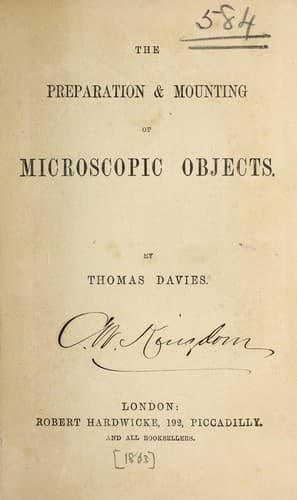
The preparation & mounting of microscopic objectsDavies, Thomas
Science
The preparation & mounting of microscopic objects
Davies, Thomas
Microscopy -- Technique
26. A description of that mode of injection which is most generally
employed has now been given, but this is not the only method of
effecting our object. A most ingenious process was invented by M.
Doyers, requiring no artificial warmth, by which many beautiful objects
have been prepared. Make a solution of bichromate of potash, 524 grains
to a pint of water, and throw this into the vessels to be injected;
then take 1,000 grains of acetate of lead dissolved in half a pint
of water, and force this into the same vessels. A decomposition now
takes place in the vessels, and the yellow chromate of lead is formed.
In this decomposition, however, the acetate of potash also is formed
and as this salt has an injurious action upon the cells, Dr. Goadby
recommends nitrate of lead to be used, which preserves rather than
destroys them. He also advises the addition of two ounces of gelatine
dissolved in eight ounces of water, to eight ounces of the saturated
solution of each salt; but with this addition the hot-water bath would
be required to keep the injecting fluid liquid.
27. Many of these are best mounted in balsam, in the same manner as
those made in the ordinary way; whilst others are best shown when
preserved in liquids, for which purpose Goadby’s fluid may be employed.
28. This mode of making injections with chromate of lead is deemed by
many the best, especially where one colour only is employed. But it
must be allowed that there is a little more danger of failure where two
separate fluids are used for the same vessels.
29. We will now consider the best manner of making _transparent_
injections, which, for many purposes, possess an undoubted advantage
over the opaque ones. But it must be remembered that there are certain
subjects to which no transparent injection could be applied, as they
are too thick when in their natural state, and cutting would destroy
all that beauty which is shown by the different parts in their
relative adaptation. For those objects, however, which must be cut
into sections to display their wonders, or are naturally thin--such
as some of the finer tissues, livers, kidneys, &c.--transparency is a
great acquisition, and enables us to understand the arrangement of the
vessels more perfectly. Again, another advantage is the simplicity of
the process; no hot water is needed with some preparations, either for
the subject or the injecting fluid, which runs into the minute vessels
thoroughly and easily, whilst the cost is small.
30. For this kind of injection no colour is so commonly made use of
as Prussian blue. It is not a good one, as was before stated, for
any opaque object, as the light reflected from it appears almost
black; yet by transmitted light no colour is more useful, because
its distinctness is equally great by artificial light and ordinary
daylight. The method of preparing this, as given by Dr. Beale, is as
follows:--
Public-domain text, read in full here on John Shaqi.
Reviews
Reviews
No reviews yet
Be the first to share your thoughts on this work.
Elsewhere in the archive
Join the Discussion
Join the discussion
Sign in to leave a comment or review.
Sign InorCreate an account