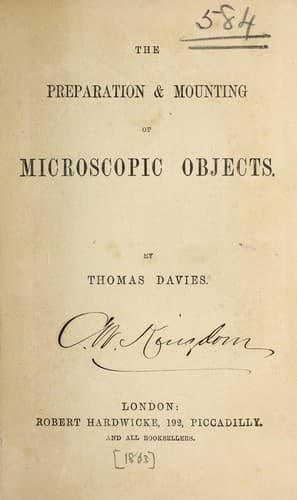
The preparation & mounting of microscopic objects — John Shaqi
The preparation & mounting of microscopic objectsDavies, Thomas
Science
The preparation & mounting of microscopic objects
Davies, Thomas
Microscopy -- Technique
In some cases, however, it is best to divide the gathering as a
_preliminary_ operation, which may be done by agitating it in a
quantity of water and decanting what does not readily subside. The
heavier and the lighter portions are then to be treated as two
separate boilings. But when the cleansing has been carried to the
above stage and this division is required, the plan must be somewhat
as follows:--The gathering must be shaken in a test-tube with six
inches of water, and then allowed to subside until one inch at the top
remains pure. About three inches are then to be carefully withdrawn by
a pipette, when the tube may be filled up and the operation repeated.
The three lower inches also may then be decanted and examined. The
gathering is thus divided into three portions, viz.--that which was
withdrawn by the pipette, that which remained floating in the lower
three inches of water in the tube, and that which had settled at the
bottom. An examination of these will inform the operator how to obtain
that particular density of gathering which he desires, and how far it
is worth while to refine this process of elutriation; for in cases of
necessity any one, or all three, of these densities may be operated
upon in the same way to separate a particular diatom.
As occasional aids, it may be remarked, that in some cases _liquor
ammoniæ_ may be used in place of water, as it often separates fine
dirt, which is not otherwise easily got rid of. Some fossil deposits
require to be treated with a boiling solution of carbonate of soda to
disintegrate them; but this operation requires great care, lest the
alkali should destroy the diatoms. Vegetable silicates also sometimes
require to be removed by a solution of carbonate of soda; but as the
frustules of the diatoms themselves are but _vegetable silica_, even
more care is required in this case. It may be well to mention, that
some diatoms are so imperfectly siliceous that they will not bear
_boiling_ in acid at all. Some of these may be allowed to stand in cold
nitric acid some time, whilst others of a smaller and more delicate
character should, when possible, be treated with distilled water alone.
Public-domain text, read in full here on John Shaqi.
Reviews
Reviews
No reviews yet
Be the first to share your thoughts on this work.
Join the Discussion
Join the discussion
Sign in to leave a comment or review.
Sign InorCreate an account