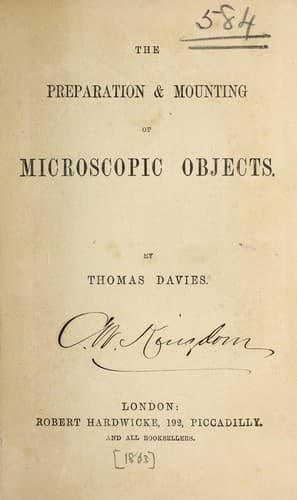
The preparation & mounting of microscopic objects — John Shaqi
The preparation & mounting of microscopic objectsDavies, Thomas
Science
The preparation & mounting of microscopic objects
Davies, Thomas
Microscopy -- Technique
beautiful when viewed with a tolerably high power. The number of
foreign ferns now cultivated in this country has greatly widened the
field for research in this direction; and it may also be mentioned
that the under-sides of many are found to be covered with “scales” of
very beautiful forms. A small piece of the frond of one of these may
be mounted in its natural state, but the removal of the “scales” for
examination by polarized light will be described in another place. The
mosses also are quite a little world, requiring but a low power to show
their beauties. The leaves are of various forms, some of which resemble
beautiful net-work; the “urns” or reservoirs for the spores, however,
are perhaps the most interesting parts of these objects, as also of
the “liverworts” which are closely allied to the mosses. These “urns”
are generally covered by lids, which fall off when the fruit is ripe.
At this period they are well fitted for the microscope. The common
screw-moss may be found in great abundance, and shows this denudation
of the spores very perfectly. Many of these may be easily dried without
much injury, but they should also be examined in their natural state.
The student should not omit from his cabinet a leaf of the nettle and
the allied foreign species, the mystery of which the microscope will
make plain. The hairs or stings may also be removed, and viewed with a
higher power than when on the leaf, being so transparent as to require
no balsam or other preservative.
There are few more interesting objects than the _raphides_ or
_plant-crystals_. These are far from being rare, but in some plants
they are very minute, and consequently require care in the mounting,
as well as a high magnifying power to render them visible; in others
they are so large that about twenty-five of them placed point to point
would reach one inch. Some of these crystals are long and comparatively
very thin, which suggested the name (_raphis_, a needle); others are
star-like, with long and slender rays; while others again are of a
somewhat similar form, each ray being solid and short. If the stem
of rhubarb, or almost any of the hyacinth tribe, be bruised, so that
the “juice” may flow upon the slide, in all probability some of these
crystals will be found in the fluid. To obtain them clean, they must be
freed from all vegetable matter by maceration. After this they must be
thoroughly washed and mounted “dry.” They are also good _polarizing_
objects, giving brilliant colours; but when used for this purpose
they must be mounted as described in Chapter III. A few plants which
contain them may be mentioned here. The Cactaceæ are very prolific; the
orchids, geraniums, tulips, and the outer coating of the onion, furnish
the more unusual forms.
Public-domain text, read in full here on John Shaqi.
Reviews
Reviews
No reviews yet
Be the first to share your thoughts on this work.
Join the Discussion
Join the discussion
Sign in to leave a comment or review.
Sign InorCreate an account