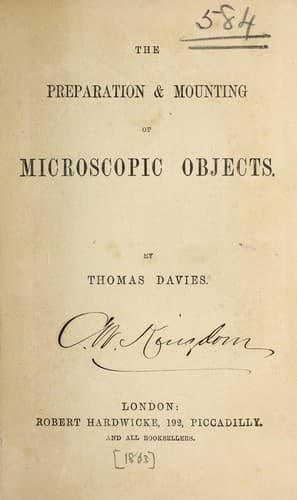
The preparation & mounting of microscopic objects — John Shaqi
The preparation & mounting of microscopic objectsDavies, Thomas
Science
The preparation & mounting of microscopic objects
Davies, Thomas
Microscopy -- Technique
Insects which are very transparent, or have the “metallic lustre”
with which any medium would interfere, are mounted “dry.” The
diamond-beetle, before mentioned, is a splendid example of this;
the back is generally used, but the legs, showing the curious feet,
are very interesting objects. Indeed, amongst the legs and feet of
insects there is a wide field of interest. When they are of a “horny”
nature, it is best to dry them in any form preferred, but to use no
pressure; when, however, they are wanted flat, so as to show the feet,
&c., extended, they must be dried with a gentle pressure betwixt
blotting-paper if possible. But this will be treated more fully in
Chapter III.
The _eyes of insects_ are sometimes allowed to dry in their natural
shape, and mounted as opaque objects; but generally they are used as
transparencies in balsam or liquid, so the description of the treatment
which they require will be deferred to Chapter III.
Hairs, when not too dark, are sometimes transparent enough when mounted
dry, but are usually mounted in balsam. These also will be more fully
noticed in another place.
These are a few of the objects which are often mounted dry, but some
of them should be shown in balsam or liquid also, and there is much
difference of opinion as to the best way of preserving others. This,
however, is explained by the transparency which the balsam gives
interfering with one property of the object and yet developing another
which would have remained invisible if preserved dry. The only method
of overcoming this difficulty is to keep the object mounted in both
ways, which is comparatively little trouble.
I may here mention that many prefer the lieberkuhn for the illumination
of opaque objects; and a good background is gained by putting upon the
under side of the slide, immediately beneath the object, a spot of
black varnish, which does not interfere materially with the light.
CHAPTER III.
MOUNTING IN CANADA BALSAM.
The nature and use of this substance has been before spoken of, so the
method of working with it may be at once described.
Perfect dryness of the objects is, if possible, more necessary in this
mode of mounting than any other, as dampness remaining in the object
will assuredly cause a cloudiness to make its appearance in a short
time after it is fixed. Where pressure does not injure the specimens,
they are most successfully treated when first dried betwixt the leaves
of a book, or in any other way which may prove most convenient, as
noticed in Chapter II.
Before describing the methods of proceeding with any particular
objects, general rules may be given which should be observed in order
to succeed in this branch of mounting.
Public-domain text, read in full here on John Shaqi.
Reviews
Reviews
No reviews yet
Be the first to share your thoughts on this work.
Join the Discussion
Join the discussion
Sign in to leave a comment or review.
Sign InorCreate an account