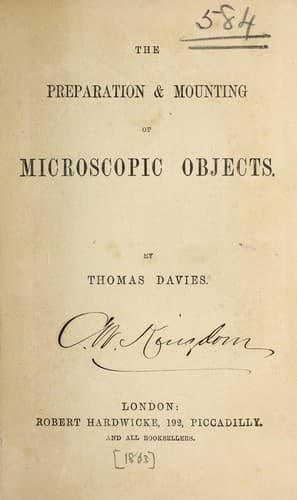
The preparation & mounting of microscopic objectsDavies, Thomas
Science
The preparation & mounting of microscopic objects
Davies, Thomas
Microscopy -- Technique
As the object is to be thoroughly immersed in the balsam, it is evident
that when it has once been covered, so it must remain, unless we again
free it by a process hereafter mentioned, which is very troublesome;
and on this account there must be nothing whatever in the balsam except
the object. The inexperienced may think this an unnecessary caution;
but the greatest difficulty he will meet with is to get rid of minute
bubbles of air, perhaps invisible to the naked eye, which appear
like small globules when under the microscope, and render the slide
unsightly, or even worthless. Ten objects out of eleven contain air, or
at least are full of minute holes which are necessarily filled with it;
so that if they should be immersed in any liquid of thick consistency,
these cells of air would be imprisoned, and become _bubbles_. The air,
then, must be got rid of, and this is usually accomplished by soaking
for some time in turpentine, the period required differing according
to the nature of the object. In some cases, the turpentine acts upon
the colour, or even removes it altogether, so that it must be watched
carefully. Often, however, this is an advantage, as where the structure
alone is wanted, the removal of the colouring matter renders it more
transparent. There are objects, however, which retain the air with such
tenacity that soaking alone will not remove it. If these will bear heat
without being injured, they _may_ be boiled in turpentine, or even in
balsam, when the air will be partly or totally expelled. But where
heat is objectionable, they must be immersed in the turpentine, and so
submitted to the action of the air-pump. Even with this aid, sometimes
days are required to accomplish it perfectly, during which time the air
should be exhausted at intervals of five or six hours, if convenient,
and the objects turned over now and then.
Sometimes the objects are so minute that it is impossible to submit
them to any soaking, and in this case they must be laid upon the slide
at once, and the turpentine applied to them there. But it must not be
forgotten that there are some few which are much better mounted in such
a way that the balsam may thoroughly surround, and yet not _penetrate_,
the substance more than necessary. Sections of teeth are amongst these,
which will be noticed in another place, and some insects (see Dr.
Carpenter) when required to show the “ramifications of the tracheæ.”
Having freed the object, then, from these two enemies--dampness and
air--we must proceed to mount it.
Public-domain text, read in full here on John Shaqi.
Reviews
Reviews
No reviews yet
Be the first to share your thoughts on this work.
Join the Discussion
Join the discussion
Sign in to leave a comment or review.
Sign InorCreate an account